In addition to elaborate multi-course banquets for every lunch and dinner, as well as private rooms in each city’s best hotels, I received tons of gifts from each local government — and sometimes company — we visited on our Anhui media tour. Actually, I’m not really sure who gave each gift, but anyway, they did NOT all fit inside this huge box, courtesy of Hefei’s Daoxianglou hotel:
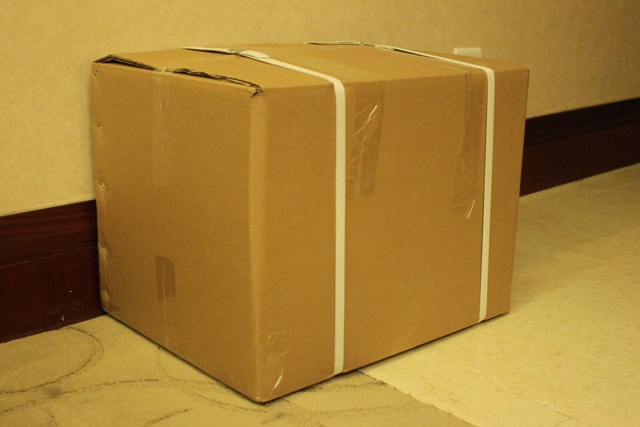
With just the presents, the box weighed about 20 kilograms. I had just enough room to wedge some shoes and scarves in, so that I could pack some more presents and work files into my suitcase. But onto the gifts!
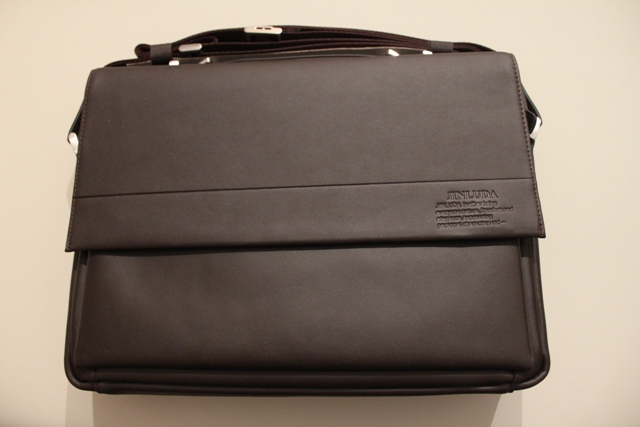 Leather bag. This Jinluda work bag thing was waiting for me when I arrived at our first hotel, in Hefei. It has a price tag of 800 RMB ($122). It’s also super Asian-looking.
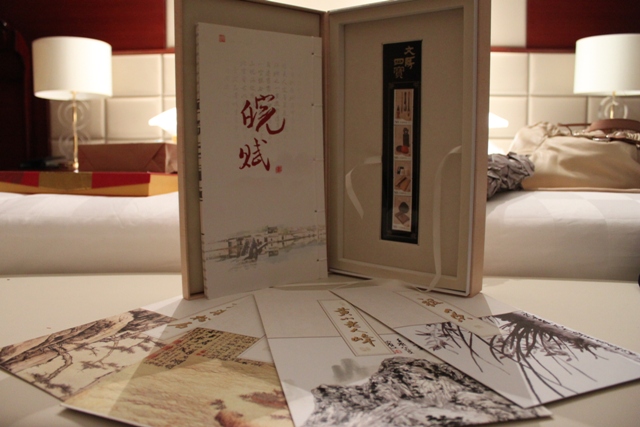 Anhui culture pack. This box was also waiting for me in the hotel room, containing a book of Anhui stamps, four Xin’an-style paintings and a glass block of more stamps.
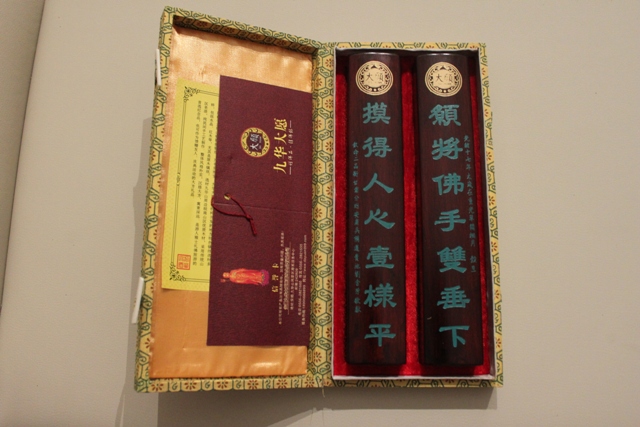 Wooden blocks with words. Any idea what these are about? I can’t remember who gave them to us, but I think it was in Chizhou. I’ve seen pairs of wooden blocks like these carved with words before but never understood their point.
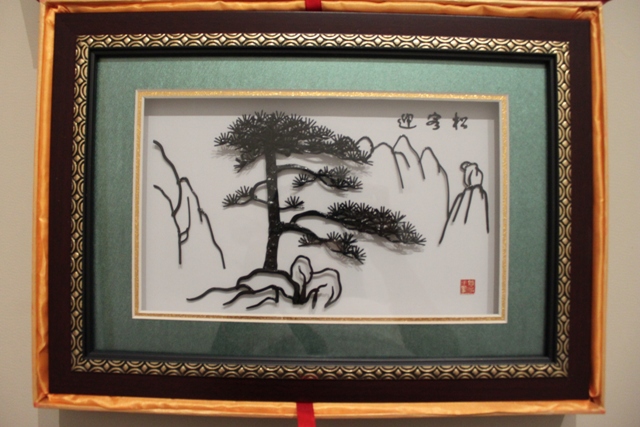 Wrought iron openwork. A picture of the local landscape, made with iron. My guess is that this is from the Wuhu government because according to my Anhui introduction book, Wuhu is famous for these things.
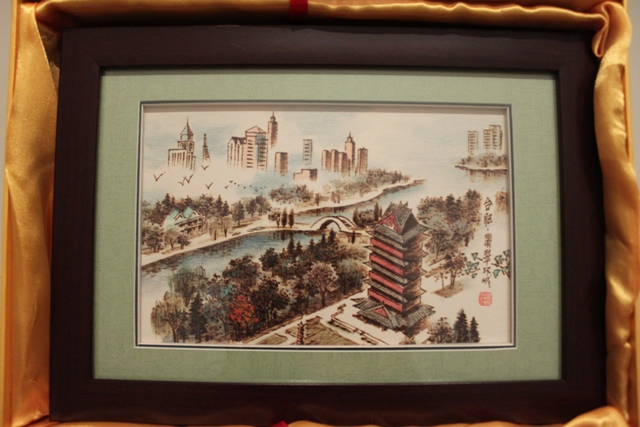 Painting. I don’t know anything about this painting. I think the box says it was painting with some kind of brush with a metal tip?
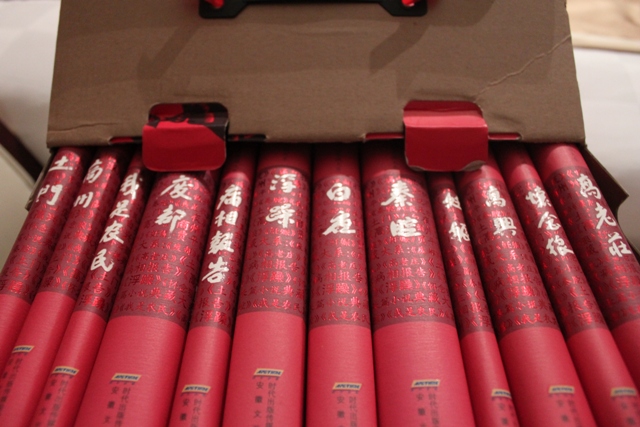
Set of 12 Jia Pingwa books. I actually love this gift, from Anhui Publishing Group. Jia Pingwa is one of the most famous contemporary novelists in China. “Turbulence” (Fu Zao, 浮躁, sixth from left) won the Pegasus Prize in 2003 and is the only book that has been translated into English (as far as I know). “Abandoned Capital” (Fei Du, 废都, fourth from left) was banned by the central government for being too sexy. When I google his name in Chinese, the results are blocked. I just wish I could read Chinese. Maybe these will help!
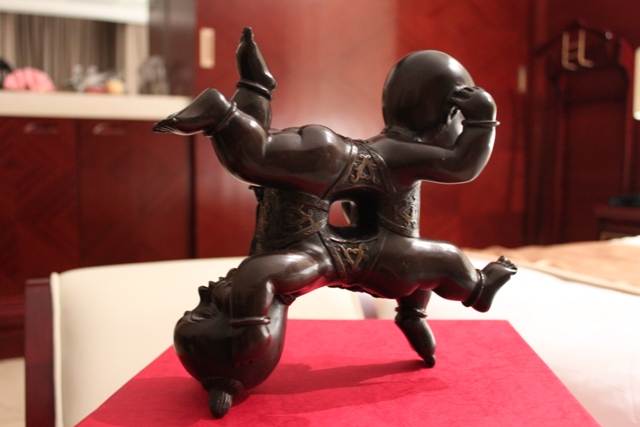 Scary baby sculpture. I deliberately avoided taking the photo with a full view of the baby’s face. As you can see, there are two of them, connected to each other, doing some kind of acrobatic lifting and posing. Depending on your point-of-view, they are either back-to-back or stomach-to-stomach. But the freakiest part is that, no matter which way you look at it, it will always be two babies conjoined and LAUGHING ABOUT IT.
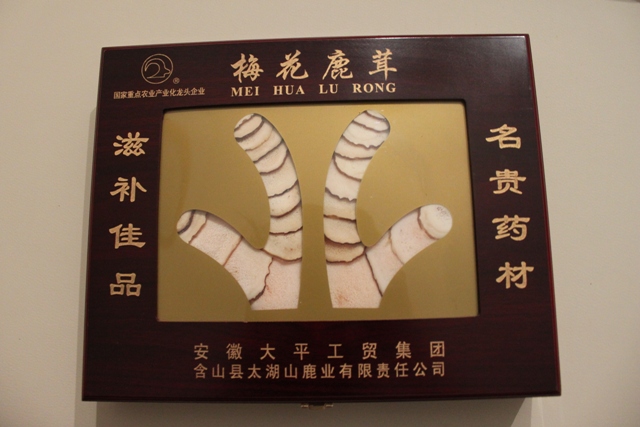 Deer antlers. Not intact deer antlers, but deer antlers that have been cut into thin slices and arranged in a fancy wooden case with a cutout of deer antlers — haha! It’s called lu rong, which according to Nciku, is “pilose antlers of a young stag.” “Pilose” means its hairy. My mother got really excited about this. It’s for medicinal purposes and very expensive. It’s apparently for older women, so she’s never had any. You grind it up and mix it with hot water and drink it. Or add it to food, maybe. According to healthphone.com (??), it tastes “sweet and salty” and acts on the “liver and kidney channels.” But according to cultural-china.com (??), it promotes the “secretion of marrow and other bodily fluid” and “increase[s] sexual potency.”
Oh, and in case you’re wondering about how these antlers are obtained:
[T]hey are good enough to be cut in the third year. Spring and summer are the seasons for collecting pilose antlers.
Another pair of antlers shall grow where the first pair were cut, which means a young stag has to endure the painful and bloody experience once a year.
So, antlers are only sawed off once a year, not like, all the time or anything. Lucky stags!