Remember that derecho that passed through Washington, D.C., last month that left 1.5 million people without power? That was a storm. Rain and winds up to 90 mph, knocked-down trees, caved-in roofs, minor flooding — not saying some of those things couldn’t have been avoided (most of all the week-long power outage), but it’s hurricane-like weather. There’s only so much you can do to protect yourself.
What happened in Beijing on Saturday? Moderately heavy rain that lasted from noon to late in the night, with a little lightning and thunder thrown in for good measure. This is similar to your typical summer thunderstorm, except that it lasted for 14 hours. The city averaged 6.7 inches of rainfall, with a distant suburb recording 18 inches of rain. It was the heaviest rainstorm in more than 60 years.
And yet, it’s just rain — 6.7 inches of over the span of more than half a day.
Why, why, why, then, did the roads look like this?
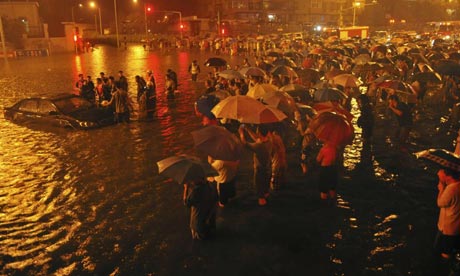
Why did 37 people have to die?
Why did so many roofs cave in? Our bartender, whose bar had its own hole in the roof, said all the repairmen were booked up on Sunday.
Why were the roads all blocked, making it nearly impossible to catch a bus to go anywhere?
Look, I’m no China expert, but I’ve been in Beijing long enough to know that this city can’t handle any amount of rain whatsoever — which is silly because summer storms are quite frequent here. Moreover, it’s the Chinese capital, or from a government official’s point-of-view, the grand showcase of China. One hour of rain, and the back alleys of Sanlitun are completely drowned in ankle deep water. Even Tiananmen Square, the heart of the China, turns into one giant pool. This is not something you would want to show off, if you were a government official.
Many people have noticed the No. 1 culprit behind the flooding: crappy infrastructure and poor planning. Beijing is literally paved over with roads and giant sidewalks. Their buildings and building complexes are ginormous, set away from the road, but every inch between them is paved over. I can’t even remember the last time I saw grass. But all cities are concrete jungles, you say? Beijing is not really a city, it is a land of malls that you’d find in suburbia USA and skyscrapers surrounded by parking lots. So it’s not like it doesn’t have green space, they just decided to pave it all over.
The lack of green space wouldn’t be such a problem, though, if city officials knew how a proper drainage system works. There are always giant puddles at intersections by the sidewalk and a drain that is 3 feet away on top of the slope. If I knew any of them, I’d offer them this sage advice: Don’t put the damn drains away from where the water collects. Water flows down to the lowest point. Put a drain there.
Also, the person who said this should be fired:
“In just one day, it rained as much as it normally rains in six months in Beijing,” said Zhang Junfeng, a senior engineer from the Ministry of Transport who runs weekend tours of Beijing reservoirs and gives lectures on water conservancy. “No drainage system can withstand rains this big.”
Flooding — it happens! But not to this extent over 6 inches of rain delivered over half a day. As someone who grew up along the Eastern seaboard and has experienced stormier storms, Beijing is lucky it doesn’t get hit by hurricanes. If it could barely survive this kind of rainfall, then it’s going to get slaughtered in an actual big storm.
Sigh. Third world problems.
On a brighter note, the rain did end Beijing’s 13-year drought.
So, I guess this means you put your new rain boots to good use?