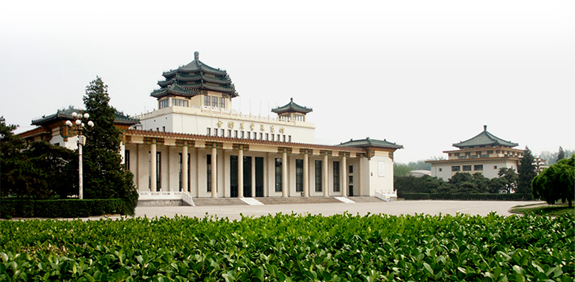
On one of my first weekends in Beijing, I was invited to go out to Sanlitun by someone else who was also new to the city. It was the first time I had heard about it, and needless to say, he gave me shitty directions: “It’s near the [subway] stop either before or either the Agricultural Exhibition Center.” He couldn’t remember what the name of the actual subway stop was (it’s Tuanjiehu). However, the Agricultural Exhibition Center (全国农业展览馆) is one of the few stops that’s not in Chinese*, though ironically, despite its English name, it’s not really a place that many foreigners would go**. Situated at the end of Dongzhimen Outer Street on the East Third Ring Road, it is first buffered by a 10-lane wide entrance and a sprawling expanse of pavement. Finally, at the end of this plaza, the main building rises imposingly, flanked by a few other smaller-but-still-large side buildings. Unlike other government buildings, such as the Great Hall and National Museum around Tiananmen Square, which are textbook Soviet-style monoliths of functionalism, the Agricultural Exhibition Center actually has hints of traditional Chinese architectural flourishes. Unfortunately, its very name acts as a deterrent for would-be visitors. What goes on at an exhibition center for agriculture — grain displays? Not a very exciting prospect. On top of that, any chance it could have had is completely wiped out by the fact that there is nothing else around it. Its dedicated subway stop only has two exits, one at each end of its entrance (yes, the entrance spans the length of a whole subway train). Across the street are heavily gated embassies, and for anything down the street, you’d be better off getting off at the next subway stop. Still, it’s probably one of the first landmarks that foreigners can locate, simply because it has a convenient English name.
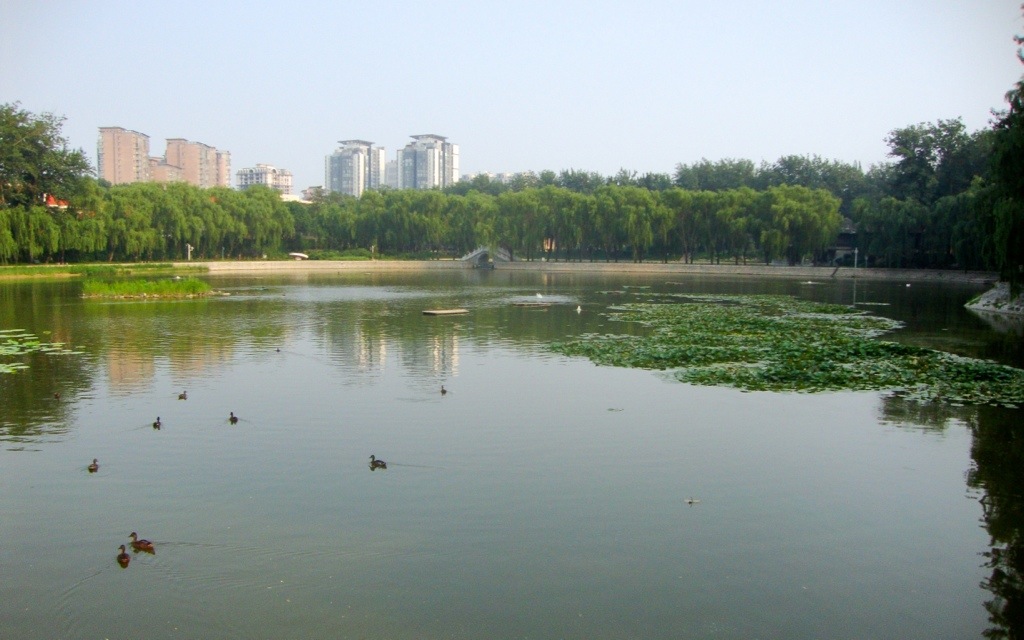
Anyway, a friend and I decided to check it out yesterday. Currently, there is a 外贸 (waimao) market going on in one of the side halls. Dozens of manufacturers from around the country that produce goods destined for foreign trade have set up stalls inside to sell off some heavily discounted wares that perhaps did not meet quality standards, but were nonetheless still suitable for sale, at least in China. I snagged a silk scarf for 50 yuan ($8.15), a bargain considering that name-brand scarf shops can sell them for more than 10 times as much. But the nicest surprise about the Agricultural Exhibition Center, and the reason we went to check it out, was the landscaping behind the buildings. A small pond, dug during the Qing Dynasty, surrounded by drooping willows, offered a tranquil spot for a stroll, a jog, or an afternoon of reading. The pond right now is half overtaken by giant lotus pads, ready for the blooms next month, but there were also a few ducks and ducklings swimming about. Even in a sprawling city like Beijing, it’s extremely difficult to find such a nice, quiet spot to relax in the shade. Parks are nice, but usually spoiled by the crowds. This spot behind the Agricultural Exhibition Center was not. My friend and I agreed to keep it that way and not tell anyone, so I guess I shouldn’t be writing about it, but I’m just too excited to have found something close by and different.
* The others are Yonghegong Lama Temple, the National Library, various railway stations, a far-out amusement park, and the even farther-out Garden Expo Center, which just opened last month.
** Once, there was a fashion show of a big designer that a bunch of celebrities attended. I thought it was Diane von Furstenberg, but Google is saying it was Hugo Boss last year. And that’s about as much publicity that I know the Agricultural Exhibition Center has gotten in the few years I’ve lived in Beijing.
Photo from China Agricultural Museum’s website.