The Third Thanksgiving

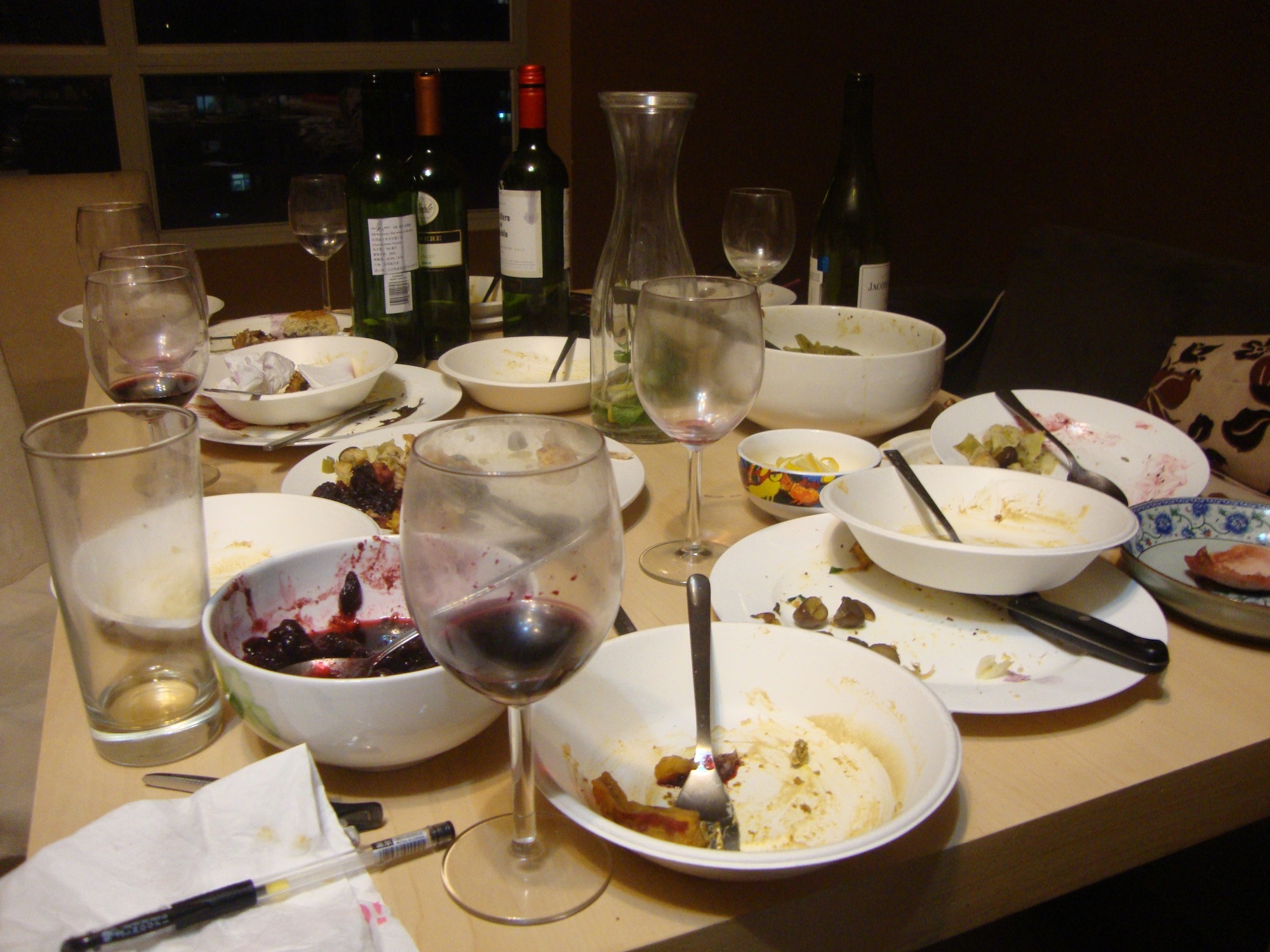
Because I usually post before shots, I will post an after shot this year:

It's hard to keep it classy when you have eight people sitting at a table for four.

While the first year, dinner was a cozy affair, and last year it was a party affair, this year fell somewhere in between. I had been looking forward to hosting Thanksgiving ever since we moved to our current place in February because it was supposed to be easier to make dinner than ever: I still didn’t get a proper oven, but I did get another conventional oven (leftover from the previous tenant), which is a lot roomier than the one I had. With two ovens, I no longer had to bake/roast things in multiple, multiple rounds. Also, my boyfriend ended up doing a lot of the chopping and cooking, so I became a head chef.

One of the more unusual aspects of China, which often goes unnoticed, isn’t the variety of cultures you can easily find here (in Beijing, at least). Instead, it’s the different people who unwittingly get pulled into foreign traditions. In terms of Thanksgiving, I ordered a roasted turkey with all the trimmings from a French butcher staffed with Chinese people. So, basically, a Chinese person using French instructions made my Thanksgiving turkey. Are there any examples in the U.S. where “real Americans” do something* for another culture’s holiday?

* Celebrating St. Patrick’s Day, Cinco de Mayo and/or Hanukkah does not count.

Scenes from the Party’s party

The prestigious China Daily has published another masterpiece, this time a photo essay of sorts that really captures the harmonious party atmosphere of the Party Congress. These are scenes from around the country featuring people from all walks of life (bonus favorite phrase of the Chinese English-language press!), all intently, joyfully and dutifully watching their government in action. Cue the minorities in minority dress, students, seniors, consumers and happy families.

I wish this was how my fellow commuters looked while the party was televised on the bus.

From Obamarama to CPC drama

I watched the election results come in yesterday morning at work (and yes, I was also proudly wearing a sticker). I don’t know if the stuffy office environment, in which I’m the only American, subdued the atmosphere, or if I was just feeling calm from a strange feeling of confidence. I watched as multiple news sites changed their calls for Ohio and Florida, as results from Western parts of the country came in and votes for Obama marched steadily on. Then, I stepped out briefly for lunch, and that seems to be when all the news networks called it for Obama. It was all Obamarama for me, but unfortunately no one in Costa Coffee seemed to care.

On the bus to work this morning, I was still feeling the effects of Obamarama while everyone else was still stoic. But even stranger, China’s own political theater had just kicked off, and the bus was showing Hu Jintao’s speech to the Congress. There were no viewing parties, no excitement, no emotion — and the Chinese are emotional creatures! To be fair, though, official speeches are snoozefests and aren’t really designed to say anything important. They literally just read off a several pages of paper and only look up every once in a while. And unlike the suspense of an almost equally divided country trying to choose between two polar candidates, the CPC Congress elections are supposed to be predictable (even though events leading up to it this year have been anything but). No, Chinese leaders don’t like sparking the emotions of their emotional subjects.

Unfortunately, this damned 18th National Congress of the CPC will last eight days, with most of the action (if any) taking place behind closed doors. So there is zero excitement and zero suspense, but lots and lots of security. This article is a great illustration of the government’s paranoia and willingness to intrude on people’s lives to protect itself. Among the security measures are:

  • Removing window handles from taxis (so passengers can’t roll down windows to throw water balloons and ping pong balls with seditious messages on them, duh)
  • Blocking online searches of “18th Party Congress” and any similar sounding words, like Sparta (“18th Party Congress” is pronounced shi ba da in Chinese, and of course Party leaders don’t want regular people to know what their rulers are up to)
  • Banning sales of knives and pencil sharpeners (so people can’t sharpen their corrupt leaders until all that is left of them is a stub)
  • Banning sales of toy planes and kites, and pigeons from going outside.

It’s actually quite nice of China that they didn’t just turn off the Internet completely, and only just slowed it down a lot and rendered most of it impossible to access. Imagine a life without Internet! Now imagine a life with Internet, but one that gives you false hope of working and then makes you tear your hair out while you try to watch a 10-minute video (say, of Obama’s victory speech), but it takes probably an hour to load and then your VPN goes out midway, so you have to start all over.

So I guess the question is: Would you rather have a year of negative political ads bombarding you every time you turn on the TV or a month (or perhaps even longer? — they’ll put an end to this when the Congress is over, right???) of weird little things that infringe on your daily life in ways you never thought possible but can actually be quite annoying?

My Internet is essentially down; here are some things from the Internet

Last week, our home Internet began crapping out. Everything took ages to load, to the point where they just didn’t load. I accidentally did something to the router and had to call a repairman to come over. Ever since then, Google barely works and I can’t connect to my VPN anymore. I don’t know what my ISP is doing, but i) they don’t speak English; ii) I don’t know anything about computers; and iii) China. In other words, this is probably a mystery that I’ll never be able to figure out.

Anyway, two China stories that have been making the rounds:

1) The story of Wen Jiabao and family’s billions: In the vein of Bloomberg’s expose of Xi Jiping’s fortune, the Times published this bombshell that got it blocked in China, too. Some people feel that this is old news; some people think it’s a big, big juicy scoop. They are both right. Officials are corrupt everywhere, whether by design or simply by virtue of being in power, so of course China’s prime minister would have dubious claims to money. But it’s cynical to just accept it without knowing exactly how any politician came into all that money. After reading the Times article, you can judge for yourself whether shady deals were made or not. It’s a shame that Chinese journalists won’t or can’t do this kind of reporting; perhaps it would better help the Party in their so-called “fight” against corruption if people knew exactly what’s happening. As the Times article points out, most times politicians don’t make their fortunes off of bribes and hong baos (the red envelopes of cash), which China already has laws against. In reality, it’s a lot more complicated.

2) The story of a former “polisher”: Eveline Chao writes in Foreign Policy about what it’s like to be a journalist in China. Her story accords with my experiences:

Unlike my American counterparts, however, I was offered red envelopes stuffed with cash at press junkets, sometimes discovered footprints on the toilet seats at work, and had to explain to the Chinese assistants more than once that they could not turn in articles copied word for word from existing pieces they found online. I also liaised with our government censor.

These things are what I remember most from my days at China.org.cn. We didn’t have our very own government censor, but censored we were. For instance, my boss once complained to me about my use of “arrested”, as in someone was arrested. I couldn’t use that word, or “detained” or “brought in for questioning”, without the police’s side of the story. Such is the sensitivity of the Chinese.

The article also does a great job of pointing out what censorship entails in China. It is not a blatant excising of references or a complete fabrication of events. Yes, there are some amateurish propaganda attempts, as well as articles that simply don’t accord with reality. But in many ways, Chinese censorship is more sophisticated:

English-language content isn’t censored as much either, since only a small fraction of the Chinese population reads English. … We couldn’t say that a businessperson came back to China from the United States after “Tiananmen,” but we could say “June 1989,” knowing that our readers knew the significance of the month. We couldn’t say “the Cultural Revolution” but could write “the late 1960s and early 1970s,” to allude to then Communist Party chairman Mao Zedong launching his disastrous campaign that sent millions of intellectuals to the countryside. Writing that a company planned to expand into “foreign markets like Taiwan and Korea” was forbidden because it suggested that Taiwan was a separate country from China, but we could say “overseas markets,” since, according to Snow, Taiwan literally is over a body of water from the mainland.

What is most true of her story, though, is her depiction of her censor, Snow. Every Chinese person knows what is sensitive, what can and can’t be published, how sensitive things can perhaps be phrased. Most of all, they know that their real thoughts, usually the opposite of what is published, cannot be said outright in the media, even though it may be said in conversation. It’s as if they were taught this in school, though of course they’re not — because these things can’t be officially acknowledged. And they all have the same reaction as Snow: That’s China!

No major insight here, just anecdotes to add to the general observation that the Chinese are willing to put up with a lot, with or without details of what they are putting up with.

Love in a time before Bo Xilai became THE Bo Xilai

The Times published a translated letter by Bo Xilai, fallen comrade, to his former paramour. If you thought I would write about how it reveals him to be an ambitious, yet reflective, 26-year-old, well, you’re wrong! I’m going to instead focus on this quote:

I am particularly fond of the maxim that you copied down: “If a person is not tenacious, decisive, and always advancing forward toward their goals, then their labor will never result in anything. I find the phrase “advancing forward” fabulous.

In Chinese, is it possible to advance backwards? Because, as an editor, I find the phrase “advancing forward” not fabulous, but redundant.

It seems that the term Bo used was “锐进” (rui jin), which some dictionaries have translated as “to advance” or “progress”, while Google Translate has simply pinyin’d the word.

If you break down the characters, however, “锐” means something like acute, sharp, intense, vigorous and so on. “进”, by itself or first, mostly means “to enter”, but when used as a second word in a phrase, it’s “to go forward” (a la “前进” from the national anthem”). So very technically, 锐进 does not mean “advance forward”, it means “super quickly advancing”. Or so my amateur translation skills tell me.

There’s just got to be a better way to get this point across in English than “advance forward.” But I can’t think of any that wouldn’t alter the phrase altogether: “and always vigorously advance toward their goals”? Sounds clunky and awkward.

I <3 Hong Kong! (A picture story)

Every time I go to Hong Kong, I fall in love with it more. It feels kind of like downtown Manhattan, except filled with all of my favorite Chinese things.

Here are a few things I love about Hong Kong:

Better Pocky flavors!
Cheap dim sum, anytime!
Bakeries everywhere stocked with BBQ pork buns and egg tarts!
Beijing is 1,967 kilometers away!
Boats! (OK, this was actually in Macau.)

Chinese cities

From the FP Cities issue, two opposing views of Chinese cities:

1) They’re all the same, says Isaac Stone Fish in “Unlivable Cities”:

Why are Chinese cities so monolithic? The answer lies in the country’s fractured history. In the 1930s, China was a failed state: Warlords controlled large swaths of territory, and the Japanese had colonized the northeast. Shanghai was a foreign pleasure den, but life expectancy hovered around 30. Tibetans, Uighurs, and other minorities largely governed themselves. When Mao Zedong unified China in 1949, much of the country was in ruins, and his Communist Party rebuilt it under a unifying theme. Besides promulgating a single language and national laws, they subscribed to the Soviet idea of what a city should be like: wide boulevards, oppressively squat, functional buildings, dormitory-style housing. Cities weren’t conceived of as places to live, but as building blocks needed to build a strong and prosperous nation; in other words, they were constructed for the benefit of the party and the country, not the people.

Even today, most Chinese cities feel like they were cobbled together from a Soviet-era engineering textbook. China’s fabled post-Mao liberal reforms meant that the country’s cities grew wealthier, but not that much more distinct from each other. Beijing has changed almost beyond recognition since Deng Xiaoping took power in 1978, but to see what Beijing looked like in the past, visit a less developed part of China: Malls in Xian, a regional hub in central China famous for its row upon row of grimacing terracotta warriors, look like the shabby pink structures that used to dot western Beijing. Yes, China’s cities are booming, but there’s a depressing sameness to what you find in even the newest of new boomtowns. Consider the checklist of “hot” new urban features itemized in a 2007 article in the Communist Party mouthpiece the People’s Daily, including obligatory new “development zones” (sprawling corporate parks set up to attract foreign direct investment), public squares, “villa” developments for the nouveau riche, large overlapping highways, and, of course, a new golf course or two for the bosses. The cookie-cutter approach is such that even someone like Zhou Deci, former director of the Chinese Academy of Urban Planning and Design, told the paper he has difficulty telling Chinese cities apart.

2) They might look the same, but they’re distinguished by their geography and culture, says Christina Larson in “The Souls of Chinese Cities”:

China’s fast-growing megacities — 43 cities of one-million-plus today, and a projected 221 by 2025 — may at first blush look homogenous and interchangeable, but of course a metropolis is more than a collection of buildings, and foundations aren’t only poured in concrete. With few exceptions, China’s most significant modern metropolises have varied, lengthy, and winding histories. At a recent literary event in Beijing, the author and New Yorker contributor Zha Jianying was asked to explain if and how “history and modernity coexist” in China. Zha, who publishes in both Mandarin and English and is one of today’s most insightful writers in explaining China to the West, and vice-versa, mused: “It depends on what history you care about. People care about living history — the language, the cuisine. But architecture?” She paused. “Every new dynasty would burn the old palace and build anew. It’s very different in that sense than Europe … There’s a long venerable history of destroying the old.”

Beijing is an extraordinary and dynamic city, and my current home, but it’s perhaps overrated — at least as a prism for understanding China. For unlike many countries that at one time or another in history have laid some claim to being or becoming the new center of the universe, China has never long or truly been a nation dominated by one metropolis. Beijing is not like London, Paris, Rome, Madrid, Constantinople, Cairo in the sense of having been the constant seat of empire (China has hadsix historic capitals), or even as a bellwether for a civilization’s fortunes. It has long been China’s administrative capital, but not its central marketplace, site of religious pilgrimage, industrial hub, or even popular tastemaker. In France, a common saying sums up the centrifugal force of the capital: One is said to be either “from Paris or from the provinces” – from the nation’s political and cultural center of gravity, or from the sticks. But in China, an old truism carries nearly the opposite meaning: “Heaven is high, and the emperor is far away.” In other words, the center doesn’t know about, or can’t fully control, what happens throughout China’s vast territory.

I think I fall into the first camp. Stone gives great descriptions of what a typical — and they are all typical — Chinese city is like: dreary Soviet-style buildings, pollution, traffic, etc. However, I’d also add that it’s not just that the big cities all look like big cities, or that the smaller cities look like the big cities but with fewer skyscrapers and ring roads; but that even the “historic”, “ethnic” or “AAAAA National Site” attractions all look the same. Caves lit up with green, pink and blue neon lights and advertisements. Pagodas and temples with a green pond and arched stone bridges and brick-layed paths. Public parks with pedal boats and people. “Ancient” villages that were built in the last few years. There may be subtle architectural or biological differences, but they are very, very subtle.

This, of course, doesn’t mean that China doesn’t have a vast array of geographical landscapes; it’s roughly the same size as the U.S., but it has a far more diverse geography. From the desert oases of the West to the water towns of the Lower Yangtze, from the chilly Tibetan Plateau to southern China’s karst hills and caves — China’s offers unique, truly breathtaking scenery in almost every region. And of course, geography influences a city’s atmosphere. Coastal cities feel more laid back; smaller towns seem to move at a slower pace; Shanghai and Beijing seem much more cosmopolitan than any other city in China.

The thing about China, though, is that there was and is a lot of experimentation going on; however, once people find something that moderately works, they all adopt it and innovation stops. Scenic areas, cultural relics and scenes of ethnic minority life — people love this stuff! Traffic congestion, pollution — no one’s figured out how to alleviate these problems, so for now they remain. Spitting, squatting, talking loudly on cell phones — these are traits that exist in 99% of the Chinese gene pool, by my own estimates.

But there is hope that, as Larson points out, the growing competition between cities will push them to find their inner selves. Indeed, Beijing and Shanghai are nothing alike, as any Beijinger and Shanghainese will tell you. That means, theoretically, as China urbanizes, we should be able to look for its cities to develop souls. I reckon they will be easier to see once I get past all that sameness stuff.

Snapshots of the week

My last post was kind of whiny and dour, and really, I don’t despair about those things, I kind of just accept it. Stupid people are found everywhere in the world, so I hope China doesn’t come across as any worse than other places. There are certain things in my life here that I wouldn’t trade for the world.

Just from this week:

  1. The view from my office: It was actually quite smoggy on Monday, but somehow by sunset it had started to clear up, and the resulting sunset over the mountains had a reddish-purple glow. When Beijing is nice, it can be breathtaking to take in the view of skyscrapers seemingly stretching all the way out to the mountains in the horizon. Unfortunately, we’re moving offices this weekend.
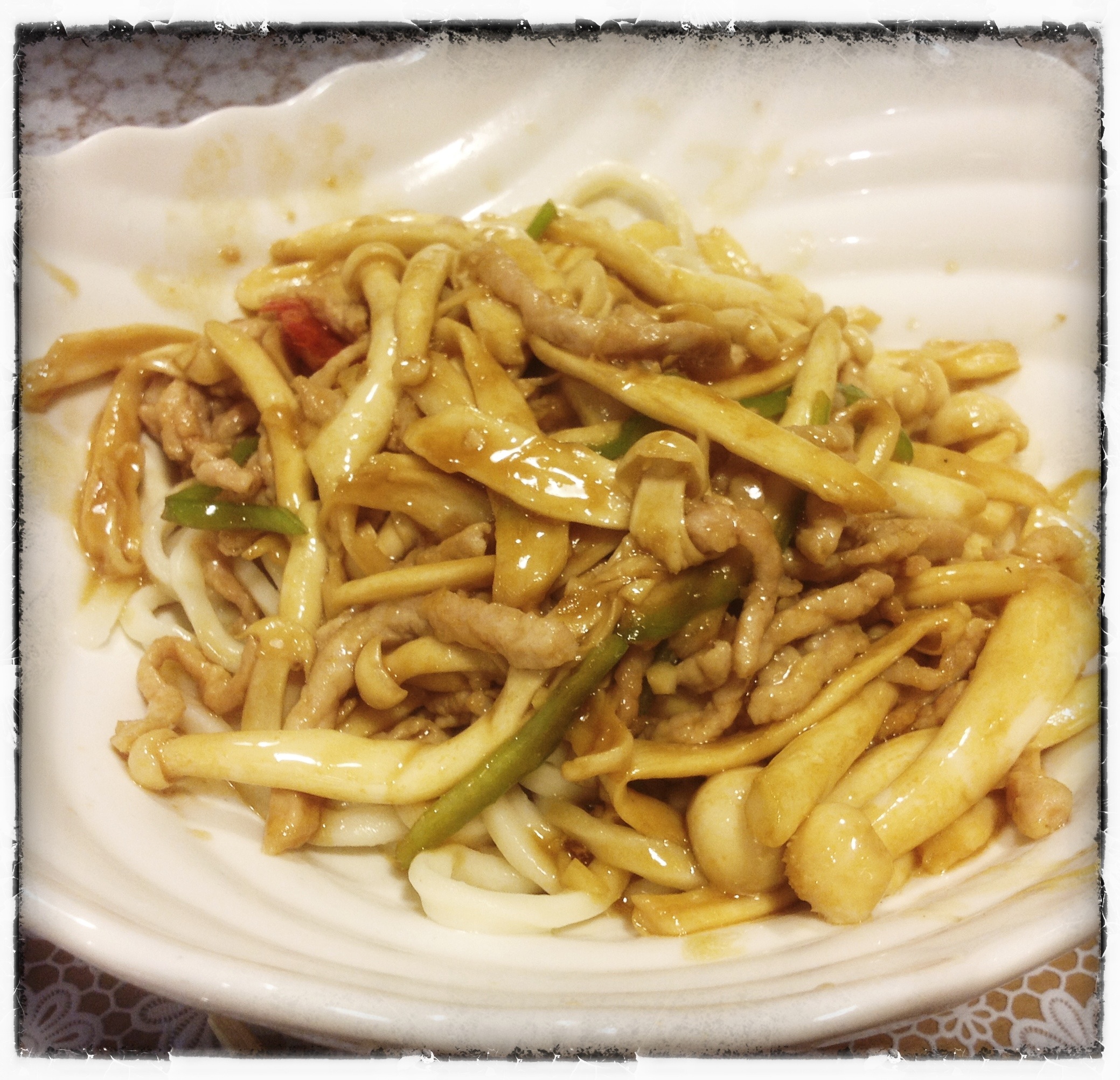
  2. Sanlitun Noodle Bar: This place serves stir-fried stuff that’s been ban‘d with mian. And every single one of their noodle dishes is delicious, so it’s always jammed pack around lunch and dinner. The best part is that it’s a family-owned shop with a streak of individualism, but its quirks aren’t weird — they work. For example, the menus are handwritten (in Chinese scribbles) on music composition books, with only a limited selection of noodle and side dishes. This is such a refreshing change from the picture encyclopedia of dishes that most Chinese restaurants offer.
  3. Huge Wave: I have found a shoe store in Beijing selling authentic designer shoes for reasonable (i.e., American) prices! That’s how I got these two pairs of BCBGs for RMB 960 (USD 151). It’s going to be tough to stay away, especially since they are having a sale now.
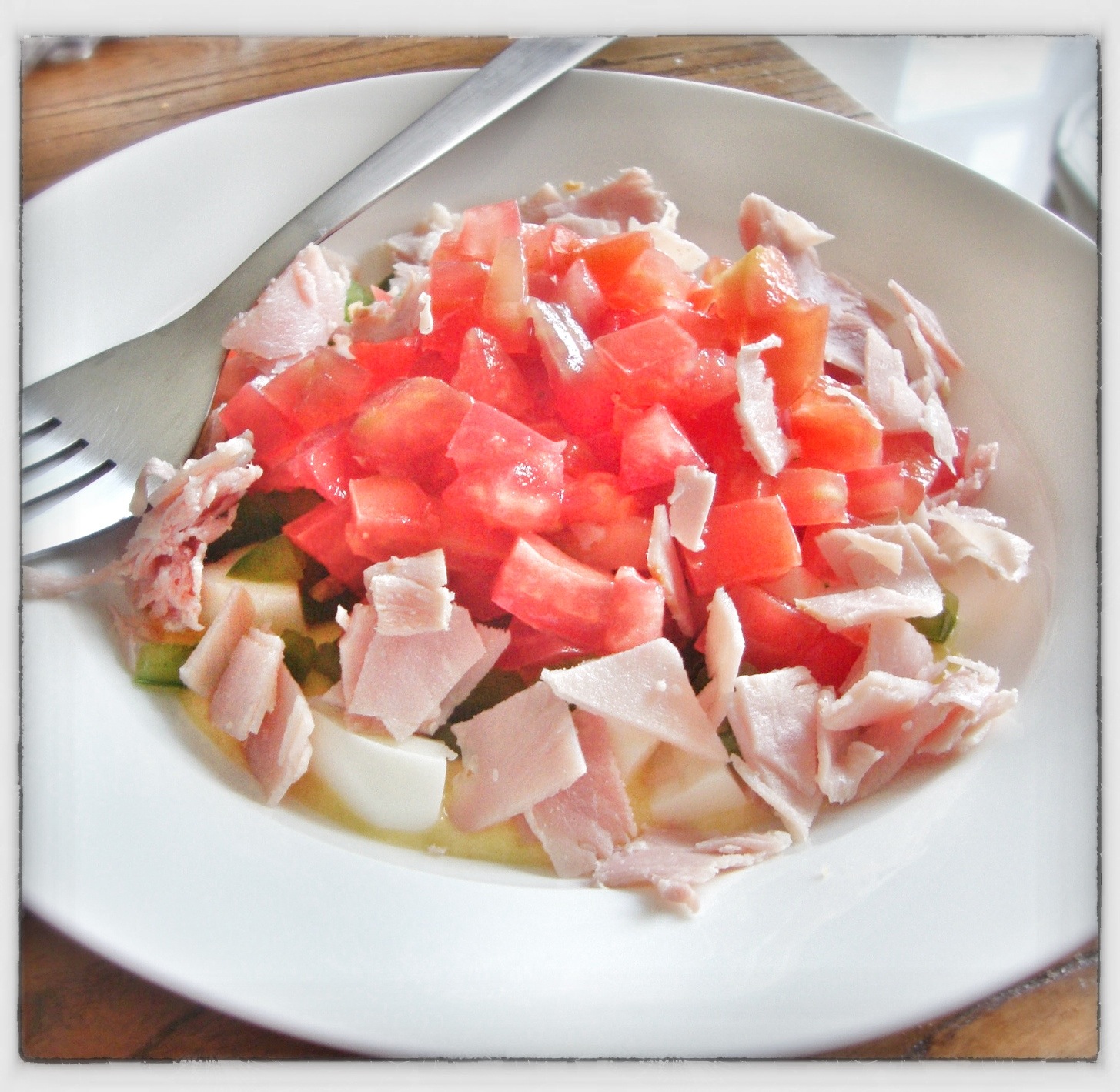
  4. Tomatoes: When they’re in season and ripe, they are oh-so-good. We made a tomato soup earlier this week that needed nothing but a little garlic, a dash of salt and a bit of cream, and then this gazpacho salad.

It’s not easy being red

This article in Prospect by Mark Kitto was so depressing to read, mostly because it’s dead accurate. People who come to China are largely idealists, ready to absorb an exotic, polar-opposite culture, widen their views of the world and humanity, and discover whatever it was they felt were missing in their former lives. Unfortunately for them, the China they heard about from afar — the one with stellar growth, abundant opportunities and anything-goes attitude — always turns out to be far different from the China they meet in person. China sucks up people’s souls and turns their hearts into little black balls of cynicism. Why? Because, as Kitto points out in the title, you’ll never be Chinese.

Not that you necessarily want to be Chinese, but China does something weird where they welcome foreigners with open arms (this is why that idiot could pen that Times column about how China wants you) and, at the same time, keep them at a chilly distance (so that Bloomberg could come back and say, no, they don’t). In the workplace, such schizophrenic mindset translates into a job position where you, a foreigner, are really just an expendable accessory:

During the course of my magazine business, my state-owned competitor (enemy is more accurate) told me in private that they studied every issue I produced so they could learn from me. They appreciated my contribution to Chinese media. They proceeded to do everything in their power to destroy me. In Moganshan our local government masters send messages of private thanks for my contribution to the resurrection of the village as a tourist destination, but also clearly state that I am an exception to their unwritten rule that foreigners (who originally built the village in the early 1900s) are not welcome back to live in it, and are only allowed to stay for weekends.

Before anyone moves to China for a job, he basically imagines that he is the wise and knowledgeable expert being called over to teach eager Chinese about how to integrate into a global society that his forbears built. It is obviously a very inflated self-view and dripping with condescension, but its premise is largely built on what the Chinese told us they wanted. I mean, they are the ones calling us “experts”. Plus, they ask us all these questions about how they can improve, as if our suggestions mean something to them. They don’t.

Meanwhile, the official (government) line is that foreigners suck:

The Communist Party of China has, from its very inception, encouraged strong anti-foreign sentiment. Fevered nationalism is one of its cornerstones. The Party’s propaganda arm created the term “one hundred years of humiliation” to define the period from the Opium Wars to the Liberation, when foreign powers did indeed abuse and coerce a weak imperial Qing government. The second world war is called the War of Resistance Against Japan. To speak ill of China in public, to award a Nobel prize to a Chinese intellectual, or for a public figure to have tea with the Dalai Lama, is to “interfere in China’s internal affairs” and “hurt the feelings of the Chinese people.” The Chinese are told on a regular basis to feel aggrieved at what foreigners have done to them, and the Party vows to exact vengeance on their behalf.

It’s kind of bewildering. For the most part, it’s not personal, but no one likes to be used as a pawn in a game of domestic political chess. And even though I know that most Chinese don’t care that I’m foreign, when I read stories like this one about xenophobic attacks, I can’t help but think that it could have been me, and that there are government-sponsored articles and influential mouthpieces that encourage it. I imagine this is how Muslims in the U.S. feel about all the anti-Islamic rhetoric coming from the Tea Partiers and Republicans, and thereby the U.S. You just honestly don’t understand how such a large group of people can say things like this.

All that aside, China has very few redemptive qualities. The standard of living is abysmal, unless you want to pay an arm and a leg for quality that would be much cheaper elsewhere in the world. There is a lack of fairness and no equal treatment. Fuses are short; rarely will you see an act of kindness, but you’ll witness an argument or fight every day. Everybody looks, acts and thinks the same. You find yourself immersed even deeper in the very materialistic culture you tried to escape:

Modern day mainland Chinese society is focused on one object: money and the acquisition thereof. … Social status, so important in Chinese culture and more so thanks to those 60 years of communism, is defined by the display of wealth. Cars, apartments, personal jewellery, clothing, pets: all must be new and shiny, and carry a famous foreign brand name. In the small rural village where we live I am not asked about my health or that of my family, I am asked how much money our small business is making, how much our car cost, our dog.

People everywhere discuss how much things cost, and we’ve all had a conversation before with a smug acquaintance who clearly just wanted to show off his new big purchase. In China, this happens way too often about things you didn’t even know you were supposed to care about. Once, I asked a neighbor about his dog. I was more focused on how old it was and its name, but he instead told me how he had bought two of them in Hong Kong for RMB 10,000 (about $1,470 back then) each. I pretended to be impressed.

To make a very long story short, it’s easy to become disillusioned in China. Very few foreigners can make it here, where they see themselves as Chinese, growing old and living out the rest of their lives in China. Even the ones who have been here for more than a decade, with families and whatnot, seem to know that at some point they will move on. Part of the reason may be us: We just don’t want to live here forever and be Chinese. But part of the reason for that is China just isn’t a place we want to be.

Somehow, though, while we are here, we manage to chug on and brush all the crap aside. Sometimes it’s even pretty easy to do. Because there’s still something about China that makes us stay, root for it, and maybe even call it home.
Weekend fun: Peach shortcake

Once, when I was very young (i.e., impressionable), my sister told me she had just eaten a peach with a worm in it. Not that she ate the worm or anything, but she saw it wriggling around in the peach and, I guess, ate around it. To this day, I wonder why she didn’t show it to me because I would’ve been so grossed out. She’s just too greedy!

Anyway, being the older one, she is always imparting knowledge on me: indeed, I learned a very important lesson that day, despite not seeing the nasty little creature. The horror that I imagined my sister feeling, which she didn’t actually feel, was forever imprinted on my fragile young mind. From then on, I refused to eat any large fruit resembling peaches — you know, like apples, pears and plums — that had not first been cut into slices. (Not that I used to go around biting into any old fruit, but that was out of laziness, not terror.)

This tactic has served me well for the past 15 or so years. I’ve never once come across a nasty little worm in any of my fruit. My worst nightmare has remained just that — a nightmare, with practically no basis in my reality — and I was really perfectly content to be terrified without having the actual experience. Alas, the old adage of “There’s a first time for everything” reared itself, and behold, I was dicing a peach to make my blueberry peach smoothie when I saw a tiny black thing not even a centimeter long sort of wriggling away from my knife. What is that? My brain went through a series of Rapid Response thoughts one by one, each lasting no more than a mere flash, but which are still nonetheless well-documented in my memory now. It was all over in less than a second, but when I replay it in mind, it’s a lot longer. Oh no, this isn’t happening to you. That’s not, oh god, please no, it is. That’s a tiny black worm in your peach! I simultaneously threw down the peach and knife, screamed and backed away as far as I could (but my kitchen is pretty tiny).

Anyway, that old adage, while certainly a wise one, neglects to mention that there’s usually a second time as well. There I was, facing my fear and making peach shortcake yesterday, when I decided to inspect this little white-ish speck that seemed to be growing and wriggling a little out of the peach as I was peeling it. Oh my god, I’ve just cut a worm that was in my peach in half! Both of its halves are still wriggling! And holy crap, maybe it was in the process of regenerating itself when I threw it into the food scraps bin? I can’t control what I think during my Rapid Response, and I can’t really control what I do, either. Despite having already lived through one worm in my peach, I let out a blood-curdling scream, threw everything down and tried to wash my hands and mind of what had just happened, again. I may even have wept.

In the end, though, Boyfriend was a hero, calmed me down and got rid of the worm, and we still made this fabulous worm-free peach shortcake:

No worm's gonna stop me from making my dessert!

I had come across this recipe from David Lebovitz after getting the urge for strawberry shortcake and lamenting the facts that (1) strawberry season was long gone and (2) shortcake of the angel cake variety is really hard to make without the proper equipment. Lebovitz’s recipe provided me an out by using peaches and what’s essentially buttermilk biscuits for the cake part. Now, Boyfriend, who is British, has a better idea of what a biscuit is — i.e., not a cookie.

And through it all, I am trying to keep in mind what my coworker said when she found a worm in her peach last week: At least she knows the peaches are safe to eat, free from any pesticides. I just … I really, really hate bugs.