Yunnan, a holiday with Chinese characteristics

I was recently told that I suck at writing on my blog. It’s true, I am guilty. I haven’t been so inspired to write anything recently, which may be a reflection of my growing disillusionment with Beijing and China. I’ve started many posts but after writing a few inane lines, I started boring even myself.

But, now that I’m battling a bout of insomnia brought on by several anxieties, I decided to turn my sleeplessness into productivity. Plus, I feel especially reflecting in the wee hours of the morning. So here goes.

**

A month ago now (wow, time flies!), I went on a short trip to Yunnan with my parents. Just before I went, Evan Osnos at the New Yorker had a very timely and apropos piece about Chinese tour groups. It’s an excellent and lighthearted piece with some interesting observations about a more and more relevant topic — Chinese going on holiday. As they become wealthier with more discretionary income, and as China liberalizes, the Chinese are traveling more and more, and like everything to do with China, it’s having a big impact on the world and on themselves. So it’s interesting to see how they do it (what does this tell us about them?) and how it impacts their views. For example, they are notoriously insular and racist to a degree rarely seen before. Will contact with more people and cultures, on their turf, broaden the Chinese world view? It’s hard to say at this point, but Osnos makes note of many characteristics of a Chinese tour.

In the front row of the bus, Li stood facing the group with a microphone in hand, a posture he would retain for most of our waking hours in the days ahead. In the life of a Chinese tourist, guides play an especially prominent role—translator, raconteur, and field marshal—and Li projected a calm, seasoned air. He often referred to himself in the third person—Guide Li—and he prided himself on efficiency. […]

He outlined the plan: we would be spending many hours on the bus, during which he would deliver lectures on history and culture, so as not to waste precious minutes at the sights, when we could be taking photographs. […]

Li urged us to soak our feet in hot water before bed, to fight jet lag, and to eat extra fruit, which might balance the European infusion of bread and cheese into our diets. Since it was the New Year’s holiday, there would be many other Chinese visitors, and we must be vigilant not to board the wrong bus at rest stops.

Basically, there’s the stereotypical “shepherd guiding a sheep herd.” They are all wearing a custom badge to set them apart from other tour groups. They receive paternalistic advice on safety (watch out for Gypsies, don’t talk to strangers) and health (which the Chinese often discuss in a very unique Chinese way). Very importantly, they are informed the best way to maximize time for pictures — which I swear, along with shopping, is probably the main reason why the Chinese go anywhere.

(The article also includes many silly observations about Europeans and the way they do things. Really, the Chinese point-of-view is very entertaining.)

One of my friends who just graduated from university did her thesis on this very topic, actually. Her conclusion was basically that the Chinese prefer to know more historical context about the place they were going, told to them by a trustworthy, knowledgeable and authoritative expert (which a good guide would be), while Westerners prefer a more subjective and personal experience with a place. I said that was mostly true, but I couldn’t help pointing out that in lieu of a tour guide, many Westerners have a tour guidebook, which more or less points out the same banal facts a Chinese tour guide would. We might not travel in groups, but we generally all do the same things.

**

I’ve been on two Chinese tours now, including to Yunnan. Somewhat different than Osnos’s tour, the ones I went on consisted of overseas Chinese coming to China. But this fact didn’t seem to make much difference on the way the tour was conducted, underscoring how living abroad for three-plus decades doesn’t change some things. The Chinese like the convenience of having a tour guide, and many times the ones in my tour group would accost the tour guide with incessant questions about minutiae details.

One thing I noticed that was absent on Osnos’s tour but ever-present on mine: the various business deals struck between the tour company and the “activities” on our itinerary. Tourism in China can be a very lucrative business, and many businesses see tourists as a very good way to make lots of money. So the businesses and the tour agencies cut a deal: Bring your tourists here, they’ll get discounts and you’ll get a part of our profits. And the tourists are all too willing to abet them. Like I said earlier, one of the main reasons the Chinese go on holiday is to buy things, things they can’t get elsewhere. Often, these things are hyped by the businesses, and gullible Chinese are talked into just having to have one.

In my five days in Yunnan, half of which was spent on the bus, we went to two of these “activities.” The first was a pu’er tea tasting, which could have been pleasant but instead was an hour-long live commercial with the pretty mienu hostesses telling us all about the qualities of pu’er, how to tell good from bad and real from fake, how to make it, how to drink it (by slurping!), why they are so pretty and healthy (because they’ve been drinking pu’er tea their whole lives), and what kind of deal they are offering us. I’m telling you, the Chinese have the art of infomercials down pat.

The next activity, on our last afternoon, was billed as a traditional Chinese foot massage. Sounds lovely! But then it turned into a performance of various special medicines the business sold and how it can cure such-and-such illnesses. It included a magic show of qigong and burn cream, so I was relatively entertained while seething at their opportunism. I just wanted a foot massage! But alas, the magic show is probably more entertaining than my complaints, so I’ll elaborate on that instead.

**

Qigong is a very mysterious Chinese practice of channeling their inner qi (as in taichi, which means “air” or “breath,” but I think something like “energy” or “spirit” or even Schopenhaeur’s “will” are closer equivalents) and aligning it in some harmonious way with the elements and the rest of the body and mind. It’s supposed to make you very healthy. So this foot massage place featured a qigong master, who guided the business on its products and courses for traditional Chinese medicine practitioners. He came into our room to demonstrate how, through his qigong powers, he can make cigarette ashes dance around on a tray. Now imagine: He places his hand a couple of inches over this tray of cigarette ashes, palm down and parallel, concentrates on the task at hand, gives a little “hyup,” then lo and behold, the ashes start jumping off the tray in a little sprinkling sort of way, like how glitter looks in a snow globe. What’s cooler is that he can transmit his qi through another person. He used our tour guide to demonstrate. He held our tour guide’s hand, let out a “hyup,” and the ashes started jumping between the tray and our tour guide’s hand! Later, he said he had felt something, almost electric, moving through his body.

The next trick involved one of the products they were selling. Two helpers bring in a glowing-red iron chain, and just to show how hot it was, the salesman touches a piece of paper to it and it immediately catches fire. Then he touches the chain with his palm. The stench of burned flesh filled the room. “Ouch,” he said. “This is really painful.” He applies his company’s burn cream and then continues hawking other products. Ten minutes later, he wipes it off — and his hand was healed. Amazing! My parents bought a jar, and when they returned to the States, my dad burned his finger to a char. But he put on some of that stuff, and it healed. This has got to be some of the best burn cream ever. It puts Neosporin to shame, you know?

**

Yunnan is a lovely place, popular for its range of landscapes, which are some of the most beautiful in China. Did I mention I am in love with its clouds? Yunnan means something like “south of the clouds.” The mountains are so high (they eventually lead to the Himalayas), the clouds just roll off of them and over the valleys below. Besides that, there are so many ethnic groups giving the region an interesting array of characteristics — not quite “Chinese,” subtly vibrant and utterly foreign. I highly recommend Yunnan to future visitors of China who have limited time to experience the range of Chinese landscapes and cultures and who want to get to know a different, arguably more authentic and definitely more likable China than the “standard” China that is portrayed to the world through Beijing and Shanghai. I was only there for five days, with a group of 20 senior Chinese-American couples, with little idea of where we were and what was coming next, but too engrossed in the surrounding beauty to care.
Points from the Chinese census

China’s census results have been released. Besides numbers that verify the slowing of China’s population growth and the migration of people to cities, as well as that there are lots of migrant workers, the most interesting and relevant bit of information (for me) was that there are 107,445 laowai in Beijing. And I’m one of them!

Beijing has the third-most foreigners in China, after Guangdong and Shanghai. Actually, Shanghai has almost twice as many foreigners than Beijing, and Guangdong has more than 316,000. Still, it’s a pretty sizable number. This was somewhat surprising to me, until I remembered that not every foreigner in China is a white guy. In Guangdong, where many of China’s factories are, many foreigners are from Southeast Asia looking for opportunities. So a point that I cannot emphasis enough: China, like the U.S. once was (and still is!), has become a land of opportunities.

Picnic in the park

Spring has sprung and Beijing is now in summer mode. Luckily, boyfriend and I managed to picnic in the park on breezy, sunny day a couple of weekends ago, before I left for Yunnan on a mini-vacay and missed the remaining days of Beijing spring.

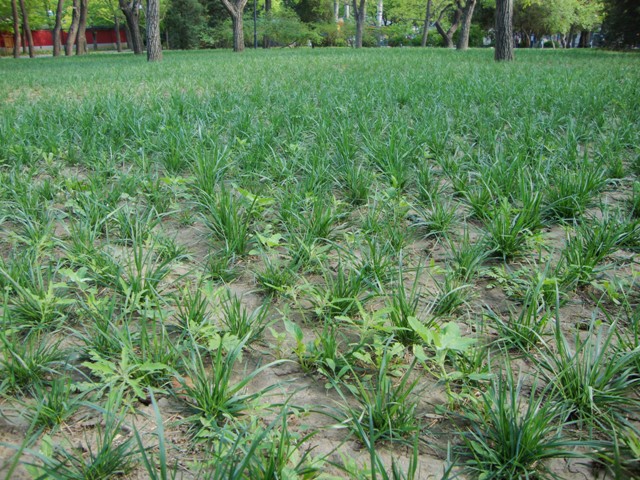
Ritan (Sun Temple) Park is a 10-minute walk due north of our building. Our first picnic was quite spontaneous, so we just bought sandwiches, chips and juice from the nearby Western food market and went in search of a nice spot to plunk down. But the grass looked like this:

A nice place to park it?

The grass looks lovely from far away, all crisp and green and trim. But when you’re staring right at it, you realize it’s planted in patches. Or tufts, if you will. Yes, they look like the tufts of hair on many a Chinese baby.

Undeterred, I plunked down anyway. It wasn’t exactly comfortable, but, well. I love picnics! It was a gorgeous day, I was wearing my picnic dress, and I wasn’t going to let Chinese weirdness or the fact that no one else was anywhere near the grass keep me from this desire I’ve had since the dead of winter. More pics inside. Continue reading

Beijing translated

One of the ways I’ve tried to improve my Chinese is by learning place names through road signs. It’s convenient because I can’t go a day without commuting and easy because signs are usually written in Chinese (character study!) and pinyin (pronunciation guide!). There are also smaller signs, such as Beijing’s famous hutongs (the alley streets) and bus routes, that are written only in Chinese, which make a great how-much-have-you-learned surprise quiz.

Alas, Chinese signs are never translated, so for added fun, I’ve always tried to translate place names and street names into English in my head. I wish I had bothered to make a map of it, but I’m lazy. Instead, the Beijinger did one of the Beijing subway, and I find it really cool. Imagine if tourists to Beijing knew exactly what it meant to be walking down Chang’an Avenue (Eternal Peace Avenue). I daresay it would cast the city in a whole new light for them. Sure, most Chinese go around without thinking twice about the road they are on (I mean, they often don’t even know), but for many foreigners — even those who know the language — it’s easy to forget that these place names actually mean something.

Click to enlarge.

Anyway, Beijing subway stops aren’t named for the streets they’re on but for the area they serve. Therefore, most of those names are the names of Beijing neighborhoods. Doesn’t Beijing sound so poetic? I get to say that I live between Nation Founding Gate and Forever Peaceful Lane. Don’t YOU wish you lived down Forever Peaceful Lane*?

*I technically live on something like Glorious Founding Road (建华路).

Updates on my Gmail

Since those pesky flower-related “protests” a month ago, Gmail has been, let’s say, not working as well as it is in the U.S. What I, and most people who use it, had hoped would be temporary has stretched into a month of frustrating, erratic and worsening load times. Even with a proxy or VPN, Gmail just doesn’t work properly. Sometimes I can access the sign-in page with relative ease, other times I have to reload once, still other times I have to reload multiple times after a “page will not load” error message and wait a few (really, like 5+) minutes before I am able to get to my inbox. And then…more loading error messages, longer wait time to view e-mails, etc. And, yes, it has stopped me from checking my e-mail so much.

Anyway, a rundown of events since my last post on the subject:

  • Google has accused the Chinese government of interfering with its email services: “Relating to Google there is no issue on our side. We have checked extensively. This is a government blockage carefully designed to look like the problem is with Gmail,” said a Google spokesman. (Some interference is happening with its other services, such as maps and documents, too, though they were not mentioned directly.)
  • The Chinese government has denied this and then refused to talk about it. According to the Guardian,

Jiang Yu, a spokeswoman for the foreign ministry, told a regular news conference: “This is an unacceptable accusation.” She declined to comment further. The ministry of commerce and ministry of industry and information technology did not respond to faxed questions.

  • At the time of the accusation and subsequent denial, GreatFirewall.biz, which tracks the effectiveness of the GFW, reported that the average download speed of Google was 34 kbps, or 45 times slower than that of QQ, China’s most popular instant messaging program, and 8 times slower than that of Yahoo. (Here’s the chart.)
  • Today, Gmail is blocked. It was working yesterday, and blocked the day before.

Some insight from Richard Parris, an expert here in Beijing on computer systems and the Internet, in Josh Gartner’s podcast on what these latest “disruptions” mean about China’s Internet censorship capabilities:

…[W]hat we’re seeing is not just an address list that’s blocked, or not just servers names and keywords that are blocked, but what appears to be some kind of understanding of the service that is provided by the page. And specifically what we’re seeing that’s really changed is very wide scale blocking of things that may be used as communication tools, as rapid communication tools, of the Facebook/Twitter kind, that have been to various degrees hyped as playing a part in recent events in the Middle East, and other places.

It’s a bit disheartening that online censorship is the area in which China, so rarely seen as an innovator, actually does appear to be a leading innovator. Also disheartening is that the Chinese government has already written off social networking tools such as Facebook and Twitter as threats and capable of bringing down the regime, while many people are still debating their actual roles in recent “revolutions” (see Malcolm Gladwell’s piece in the New Yorker last year, for example: “Small Change: Why the revolution will not be tweeted“).

To illustrate just how creepy the Google-China war is, Al Jazeera’s China correspondent, Melissa Chan, gives a detailed look at what may have been behind the hacking attacks on political activists that Google revealed on March 11. No details on where the attacks are coming from, but nevertheless, there appears to be a targeted effort to make various groups of people appear as agitators.

Life as an East Sider

Boyfriend and I moved apartments a couple of weeks ago. Now that I have had time to adjust, settle in and get the amazing dirtiness under control, I would like to say that it’s not as bad as I thought it would be.

Cons first:

  • Still pretty dirty. I have to find a carpet cleaner to come clean the carpet. Boyfriend likes the carpet, but I can only cringe every time I a loose crumb falls and disappears into the carpet-y abyss. I need a vacuum cleaner, if you’re wondering what kind of housewarming present to get me. Also, did I mention our balcony has enough sand to fill an hourglass?
  • Hot water is dodgy. But I think I may have figured it out.
  • Kind of crampy. Our apartment is something like 60 square meters, or 645 square feet, and the layout does not make efficient use of the space. I have somehow accumulated a bunch of stuff, and they do not all seem to fit well in the apartment.
  • Thin walls. Chinese walls are never “thick,” but if you’re outside my door, it’s pretty much like you’re right next to me.
  • Long, pricey work commute. I’ve bitched about this before.
  • One stove burner. I’m still afraid of it that I haven’t even tested it out yet. This, coupled with
  • No nearby supermarkets, means that I am unlikely to cook (even though I like cooking). We do have a small chao shi downstairs, though, which has some basic produce, but they neither are the highest quality nor come in a wide selection.

Neutrals:

  • Great restaurants :( My lonely stove burner and the absence of supermarkets and the abundance of good eateries mean I’m never cooking again.
  • Great restaurants! There’s a baozi shop, a cheap pho shop, a bakery, a fantastic Yunnan restaurant and several nice Western restaurants within a kilometer from our apartment.

Pros:

  • ESPN. I get it, along with CNN and a movie channel and BBC. For free.
  • Proximity. I am just south of Sanlitun and right outside of the CBD. No more traveling across the city just to go out! My taxi fare has just been cut by more than half.
  • Kind of cozy. Now that I’ve unpacked, it’s got a nice lived-in feeling.
  • Commute doesn’t feel THAT long. It takes just over an hour to get to work in the morning, and depending on how long I have to wait for the buses, about 1.5 hours to get home at night. Plenty of reading time. I’m thinking of getting an iPad or Kindle or other e-reader, in case you are wondering what kind of housewarming present to get me.

A bad day

It’s one of those “China sucks” days. To wit:

  1. They’ve been fucking with Google for the past week. This means that Gmail randomly goes down while I’m checking or writing e-mails, in the middle of uploading attachments or saving drafts. It also means that Google Maps stalls when I try to search for a specific address. GRRRRRRR. I need to find supermarkets near me!
  2. I have to report my extra earnings to the taxation bureau. And pay extra taxes. This is the equivalent of owing money to the IRS. Except with much messier (i.e., lack of) documentation. I was informed by my company’s finance office that I had additional income last year outside of what I was paid by my company. How did they know? They were alerted to some difference between what they reported and what the government reported of my earnings, which are attached to my passport number. Lesson learned: Do not have any freelance editing work payment associated with your passport number or else the government will know. I vaguely remember giving that out to someone for something, but I don’t remember what or when :(
  3. It’s really cold again for some reason (well, probably because it’s still mid-March in Beijing). It was so warm just yesterday (dress and flip-flops!), and has been for the past week at least. Now it’s just cold and grey :(

The many bribes I received in Anhui

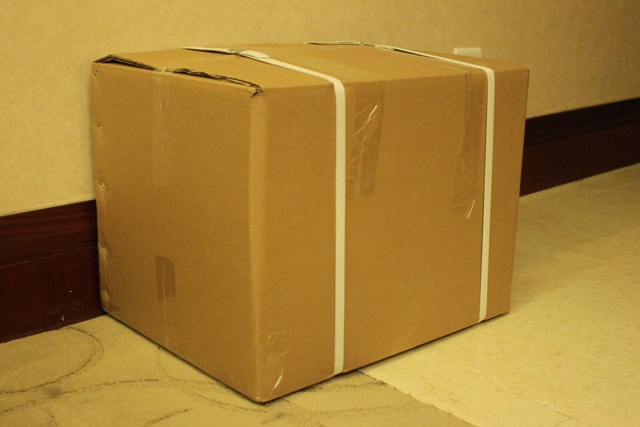
In addition to elaborate multi-course banquets for every lunch and dinner, as well as private rooms in each city’s best hotels, I received tons of gifts from each local government — and sometimes company — we visited on our Anhui media tour. Actually, I’m not really sure who gave each gift, but anyway, they did NOT all fit inside this huge box, courtesy of Hefei’s Daoxianglou hotel:

Ooooh, what's inside?

With just the presents, the box weighed about 20 kilograms. I had just enough room to wedge some shoes and scarves in, so that I could pack some more presents and work files into my suitcase. But onto the gifts! Continue reading

Big brother is watching me

This is nice. The Beijing government will start tracking all 20 million people in real-time through their mobile phones. From South China Morning Post:

Wireless communication experts said the system would be particularly useful not only for following the whereabouts of individuals but also in detecting any unusual gathering of a large number of people.

So, you know, the government can keep an out eye for protests. But wait! Knowing where I am at all times isn’t for protecting the government, it’s for my own benefit:

Li Guoguang – deputy director of the Beijing Municipal Science and Technology Commission, which worked on the project with China Mobile and, presumably, the two other state-owned mobile service providers, China Unicom and China Telecom – told the Beijing Daily that the project would be used only to ease traffic jams.

Beijing traffic is a big pain in the butt, no doubt. But I can think of more effective ways to ease jams, such as — off the top of my head — eliminating subsidies for all cars, downsizing the municipal fleet (700,000 vehicles!) and strictly enforcing all traffic laws.*

But who am I kidding? The only way to ease the traffic jams is to institute a stricter driving test that weeds out insane drivers who 1) switch lanes unnecessarily, such as into the path of an oncoming vehicle that is going faster than them; 2) turn across multiple lanes; 3) have blatant disregard for pedestrians crossing the road, bikers and the bike lane, or other drivers; 4) don’t understand road signs and have no idea where they’re going; and 5) don’t use their turn signals. Because if such a test existed, there would be no drivers in Beijing. Problem solved! No need for tracking my whereabouts.

*The only law they enforce is the speed limit — seriously! Of all traffic laws, the only one you will never find a driver breaking is the speed limit. In fact, they drive a few kilometers under the speed limit, even on the ring roads at midnight, when there are no other cars around.