And the fireworks have started

…scaring the unsuspecting and suspecting alike. They’re going off in the crowded hutongs right outside the restaurant while I’m eating dinner. BOOM. Or in a series of consecutive small blasts like machine gun fire while I’m watching tennis on TV. I think the world is ending, and then I remember that actually it just means the new year is coming. Spring Festival starts on Wednesday. Hello, Year of the Bunny!

My honey’s a bunny.

So, anyway, apart from the fear of unknowingly walking into a firework just as it’s going off, what’s not to like? No more traffic jams, fewer people, fewer dumb people. Also, it’s surprisingly warm! And boyfriend and I are going to get a bunch of fireworks ourselves to scare people with ward off evil spirits. It’s the closest I’ll ever come to blowing things up!

New year, new apartment. We signed a lease for a small one-bedroom down in Yonganli (near the Silk Street Market), which means I will be leaving my beloved Taiyangyuan for a place all the way on the other side of town, an hour from my office (or 1.5+ hour during rush hour). I’m still discovering things about this neighborhood! For example, there’s a Carrefour (the French version of Target) down the road, in the opposite direction of Wal-mart. Yes, I like being flanked on both sides by two supercenters less than 10-minutes walk away. And if that’s not convenient enough, I have a market in my apartment building complex, for the times I am extremely lazy need emergency lemons or have a fruit craving. Besides, didn’t I mention how awesome our bedroom is?

But I am trying my best to look forward to having our own place. The layout sucks, but it’s clean, has a tub and 24-hour hot water — rarities in this giant city, especially for 4,600 RMB a month. And I’ll finally be an East-sider (i.e., of higher status).
The obligatory Tiger Mom post

Well, I am the daughter of Chinese parents, which I think gives me some sort kind of authority on this issue. The opinion article by Amy Chua, which came with the incendiary headline, “Why Chinese Mothers Are Superior,” appeared Jan. 8 — almost two weeks ago — right before her memoir from which the article was adapted was released. People are still talking about it.

There are ranges of opinions. Among them is the question whether Chua actually represents the modern Asian approach to parenting. While angry “Westerners” quickly defended their own parenting style of nurture and leniency, some angry “Asian” parents say that Chua most likely represents overachieving, suburban, upper-class elites.

Indeed, there is a stereotype of Asian parents that closely resemble what Chua describes in her WSJ article — if not her book. Also, testimony from former Tiger Cubs reveal that such parenting techniques were also used on them.

I myself was not a Tiger Cub. My parents always expected me to do well in school and wanted me to be the best I could be. I was gently pushed. Questioned whether going to hang out with friends was worthy of my time. Disciplined when I was out of line. Unfortunately, I never won (meaningful) awards. I wasn’t valedictorian (my school didn’t even have them!). And now, instead of being in medical school developing cures and becoming a rock star doctor, knowing that I will buy a multi-million dollar house in a gated neighborhood within the next five years, I am goofing off in China working for a “two-bit website” that doesn’t care for or respect my informed opinions.

But I’m also just one example. There is this story in the Global Times, which appeared not long before Chua’s Wall Street Journal article (excuse the crass headline). How’s this for Tiger Parents?

For parents who love him more than anyone else on earth, they sure had a funny way of showing it to Sun Liang.

They began intensely monitoring Sun at age 5 when he started painting and calligraphy, lashing him with a leather belt whenever he failed to meet their exalted expectations.

“Life is only meaningful for those who achieve real success!” they shouted at Sun, and “You’re screwed if you can’t stand out from the common herd!” whenever he failed to ace an exam.

There were screaming arguments and physical fights, suicide attempts and nagging feelings of never being good enough. Now there is backlash from the now-grown children, which in the article takes the form of an “anti-parents” support group on a popular website.

Am I the best I can be? Is anyone? I don’t think so. I think that would require a lot of effort, and I’m fine with not being the best I could be. I think my parents are too. Do I still want to be better? Of course. But at a certain point, the happiness-per-degree-of-betterment ratio starts to get less and less, and soon it’s just not worth hours upon hours of non-stop effort.

Kitchens: A Chinese riddle

One of the truer stereotypes of the Chinese is that they take their cuisine seriously. While rapid development and modern demands of society are deteriorating their allegiance to good food, it is still generally expected that people know how to — and do — cook. Even though more and more Chinese are eating out, they still mostly cook at home.

At least, I think this is true. Now I’m having doubts.

Why, oh why, is it so hard to find an apartment with a decent kitchen in Beijing? Even the one I have now, in my rather nice apartment, comes with barely two square feet of counter space. At least it has three gas burners and a divided sink with a vegetable washer. Of the six apartments we saw yesterday, one had two electric burners, two had two REALLY old gas burners, two had two new ones, and one had one gas burner. And none had an oven.

Apartment search did not get off to a very promising start.

China is not cheap

Really.

The whole “China is cheap” myth is one I believed until after about three months of living in China. Now, a small, non-scientific study comparing cost of living in Boston and Hangzhou, a small city just outside of Shanghai, illustrates my point perfectly:

While not exactly a scientific study, Wang admits, the exercise reveals that a surprising 10 [out of 19] of the food items, including green beans and bananas, were more expensive in China. In Hangzhou, a scenic coastal city near Shanghai, the price of beef brisket per 1.1 pound, or 500 grams, and the cost of a dozen eggs were both double the prices found in Boston. A liter of milk, meanwhile, was nearly triple.

Hangzhou’s premium gasoline was also 23% more expensive, and the overall price of the entire basket of goods purchased there was 8% higher.

The average per capita income in Hangzhou in 2009 was 26,864 yuan, or $4,024, according to the Hangzhou local government. Boston’s was $32,255.

In short, things are more expensive here, and we make less money. And prices aren’t going down. The consumer price index reached 5.1 percent in November, a 28-month high, and food prices surged 11.7 percent. The government is again raising gas prices, too. News reports have been heavily focused on inflation related to the soaring housing and food prices, which alternately has caused a lot of worry and little worry among consumers.

For me, I have seen my liter of milk — that’s about a quarter of a gallon — go from 11.90 RMB ($1.79) when I first came last year to 15.90 ($2.39) today. Eggs are 24.90 RMB for a 25-egg carton, or $1.88 for a dozen. Ground beef is about 20 RMB for 500 kilograms, or $3 per pound. Chicken and pork are slightly more expensive.

But there are cheaper things as well, such as carrots, onions and potatoes.

Preparing for the holidays

I’m going home in 3 days! I can’t wrap my head around not having been State-side in more than a year. But alas, I’ll be home for Christmas in one of the most anticipated Christmases in the Yueh family history. My to-do list:

  • Presents. Check! All bought.
  • Money. Check! Converted. (Side note: a shit load of cash isn’t so cool when you’ve spent a year paying for really expensive things in cash. Has anyone seen 19,800 anything in denominations of 100? It’s amazing.)
  • Apartment. 3/4 check! Mostly cleaned. Can’t have it dirty when the new year arrives.
  • Christmas cards. 1/4 check. I’m in the process of converting non-Christmas cards into Christmas cards.
  • Packing. No check :( But at least I got my suitcase back.

Meanwhile, Mark Zuckerberg is in Beijing. Shouldn’t he be banned since Facebook is? Especially if he might be coming here to … spy*? Just add him to the list of important people who have recently visited. Off the top my head, Dianne von Furstenberg and Anna Wintour.

*By spy, I mean research stealthily, which is what Time magazine and Forbes’ Oliver Chiang speculated.

Things I (don’t) like about China, Part 3

My first two posts in this series talked about things I don’t like about China, so here’s a hodepodge of things I do rather enjoy:

Free delivery/Cash on Delivery.

These features are excellent. Imagine the convenience of ordering things online coupled with free delivery to your door the next day. If it’s food, then it’s delivered within the hour. For free. With no tipping involved. (That makes me sound kind of cheap, actually.) It sounds awesome, and China has really spoiled me in this aspect. Depending on where you order from, delivery is free. For most restaurants, such as Ganges and Tube Station, it’s free within 5 kilometers. I think there’s a nominal fee (7 kuai, or $1 dollar, or less) for McDonald’s, KFC, Pizza Hut and Domino’s. I’m not joking. And for actual goods — say if I order something off Amazon — there’s free shipping, or I can pay about 10 kuai ($1.40) for same-/next-day delivery. Do you know how much that would cost to get in the U.S.? Something outrageous. Not to mention, for all of these things, I get to pay cash on delivery. I used to hate paying in cash, but I love paying cash on delivery.

Beijing is cosmoplitan.

You may be thinking, “But wait! I thought the Chinese can’t get anything foreign right!” Or that the population of foreigners in this city is insignificant, especially when compared to other world cities — this Xinhua article says 0.6 percent of Beijing’s population are overseas citizens, compared to 30 percent in London and 28.4 percent in New York. These statements are both true, but the amount of foreigners making investments in the city definitely brings some worldly flavors here. I can find delicious New York-style pizza, Spanish beer, German sausages and even adequate fish and chips here. I get delicacies such as macarons and ice cream mochi. There’s a ton of halal cuisine. What I’m saying is, there’s something from most regions in the world here — which is enough to impress my small-town sensibilities. Besides that, I have met people from countries I’ve never even thought of — Cameroon? Latvia? — and with the expat population so small, the community is very tight-knit.

It’s easy to get out of.

It’s not easy to stay in Beijing for long periods of time. Fortunately, as one of China’s main cities, its airport offers convenient flights to many destinations, most of which I really would like to see. Tokyo, Seoul, Taiwan and Hong Kong are short stops away, and then there’s Vietnam, Thailand, Singapore, Malaysia, etc. etc. etc. If I can’t afford to country hop, China itself offers many fascinating places, from its luscious Three Gorges along the Yangtze River to desolate deserts out West. And Tibet! Plus Shanghai will soon be four hours away, instead of 10. In other words, Beijing offers a great strategic base for traveling to other places. I can’t say that for many places in the U.S.

Things I (don’t) like about China, Part 2

The Chinese don’t get a lot of Western things “right.” For instance, driving and roads, or socialism. This can’t be more true when it comes to Western food. It’s hard to figure out how to mess up spaghetti with tomato sauce, or a ham and cheese sandwich, but they do it. I shall illustrate my point using bread — everyday sandwich bread.

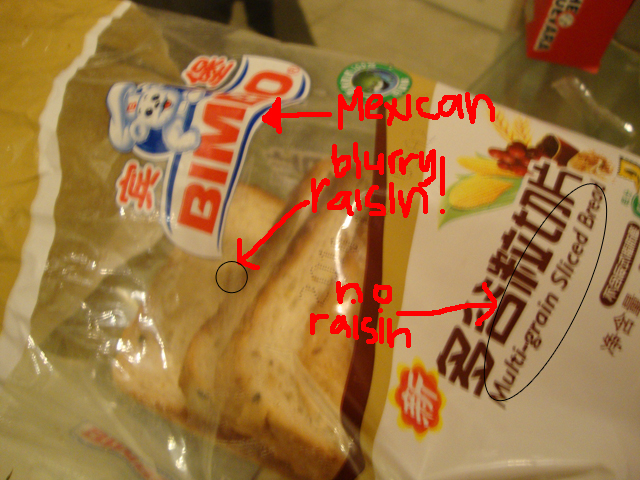
All bread in China is sweet, which is odd, considering the Asian predisposition to dislike sweet flavors. Sure, bread is a “sweet” food, in that it’s not salty, sour (except for sourdough!), or bitter. But in China, bread is sweet. I usually buy whatever store-made wheat bread is available because if I butter it well enough, I can almost ignore the sweetness. But yesterday, for my chicken salad sandwich, I bought a foreign brand of multi-grain sliced bread … and it’s sweet! And has raisins. I just don’t understand…

Sweet bread — not to be confused with sweetbreads, which I love.

52 almost down … 52 to go?

It’s official. I am now into my 52nd week of living in Beijing. What a year it’s been! This time last year, I thought this time this year, I’d be packing up, saying good-byes and getting ready for the “real world.”

Plans change.

I can’t say how much I’ve changed over the past year. Sometimes I feel like I’ve learned nothing, and other times I’m amazed at what I can pull off. Sometimes I was adamant about remaining “Western,” and other times I relaxed and let China take over. I was all very China — pulled in so many directions that I now feel like everything at once. I can honestly say that I know more about China and Chinese people now while knowing even less about them. Am I confused? Not really!

So, as an ode to my new home, I want to note some of the things I have come to appreciate and hate about China. It will be Beijing-centric, as this city has defined a lot of what I know about this country (even though I know it’s not representative of the country at all!). I’m not a China lover, like many foreigners who come from the West and subsequently “fall in love with China.” I don’t find all of it quirky or charming or interesting. I am, actually, quick to judge and slow to reflect. With that in mind, here’s one thing I hate — a lot — about China:

Bad drivers.

Every driver in China is a bad driver (this is an exaggeration). Forget those stereotypes about how Asians can’t drive. In China (Beijing), people drive between lanes, in bike lanes, on sidewalks (because that’s also where the parking spaces are!), and generally wherever their cars can fit. Drivers here have an extreme case of driver entitlement, meaning they think that they can do whatever they want and that they own the road — practically the whole drivable world — just because they’re behind the wheel. Things they do:

  • Pull out from a side street/parking lot/parking space/etc. right into oncoming traffic, causing my bus driver/taxi driver to slam on his brakes.
  • Inexplicably change lanes all of a sudden — and take forever to do so — and then switch back immediately after.
  • Turn across three lanes of oncoming traffic, instead of, you know, getting into the far lane in advance of their turn.
  • At an intersection, keep driving even after their light has turned red and/or even if there’s no room for them to go, blocking the intersection for people going the other directions.
  • Drive straight into a traffic jam, even if other roads are open and free-flowing.
  • Cut into a line of cars waiting to turn/get onto the ring road/etc.

But the worst thing about them is that they abuse their power. According to this guy who studies Beijing transportation, 40 percent of automobile use is for traveling a distance of less than 5 kilometers. Five kilometers! That’s 3 miles! This is like when I took a car between my house and my high school, which are 2.2 miles apart. Except it’s not like that because these drivers live in a city with above-average public transportation options, not to mention bike lanes, rickshaw drivers and sidewalks.

But, according to the same guy:

In London and Tokyo, the transportation in central areas mainly relies on public transit and in peripheral areas relies on cars. In Beijing, the opposite is true.

Although Beijing has fewer vehicles than Tokyo, it has more vehicles in its central areas than in Tokyo and twice as many as in New York’s Manhattan, which means that cars are overused in short-distance travel in Beijing.

In addition, Guo said that Tokyo, Paris, London and some other cities have started to increase the use of bicycles, but the proportion of bicycle travel in Beijing only accounts for 8 percent at present.

So not only are bad drivers bad at driving, they’re also driving unnecessarily, making them even worse.

The limits of my Chinese

I can, for all intents and purposes, speak Chinese. It was my first language. I grew up using it. My parents speak to me with it. I sometimes even speak to them with it. And I took four semesters of it during college.

But I’m not fluent in it.

I can say my name, where I’m from (mei guo), what I’m doing here (gong zuo), how long I’ve been here (kuai dao yi nian le), that I like it here (partially true) and that I look Chinese because I am, ethnically speaking — both my parents are. I can sort of describe what I do at work (something like a reporter, but I fix things that my coworkers have translated from Chinese to English). I can say I want to pay my phone bill at the bank (because that’s where you go to pay bills). I can call the wu ye (apartment super) to say that I have a problem and please come fix, but I can’t say what the problem is. This happened today*.

Me: Hi, there’s a problem with my window. Can you send someone to fix it?

Maintenance lady: What’s the problem?

Me: Sorry, my Chinese isn’t very good, so I don’t really know how to explain it to you. Can you just send someone to look at it?

Maintenance lady: But I need to know if it’s an electrical problem or a water [i.e., pipe] problem.

Me: Um … it’s not really either. My window … there’s water coming in.

Maintenance lady: Water? What water?

Me: Um … like water … you know, when it’s cold outside and warm inside, there’s water?

Maintenance lady: I have no freakin idea what you’re talking about.

Me: :(

Basically, what I wanted to say was, the seals on my window are coming off, so water (from condensation?) gets inside. Apparently, the term for that is “jiao shui” (浇水), which is what my mommy uses to tell me to water her plants.

But upon further research, I have discovered that it’s possible the maintenance guy could have said “jiao shui” in reference to 胶水, which apparently means  some kind of glue. Perhaps he was telling me he needed jiao shui, which he used to stick the rubber seals back where they belong.

*In Chinese, of course.

Belated holiday cheer

Black Friday sales have long since started, and I’m now just wishing everyone a happy Thanksgiving! Don’t worry, I hardly forgot about my favorite holiday. The past two weeks, I’ve been running around town getting prepared for the big meal — deciding on dishes, hunting down the ingredients, buying necessary host-wares. It was exhausting, to say the least, especially yesterday when I started cooking at about 10 a.m. and barely stopped until our 7 p.m. meal.

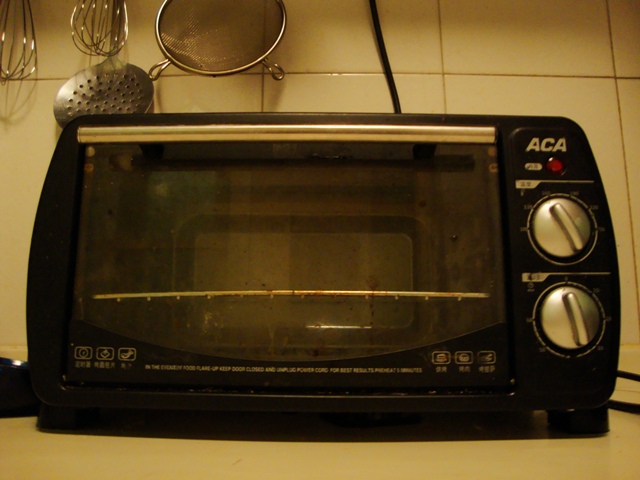
This is my oven:

Some people have two ovens. I just have this.

It’s pretty tiny. The largest pan that will fit in it, that I’ve been able to find in China, is a 7×7-inch Reynold’s disposable foil baking tray. Which is what I ended up using to bake the stuffing — in three rounds of near an hour each. Naturally, I couldn’t find a turkey small enough to fit, so I was able to use my oven as an excuse to order one. (Fact: I’ve never actually made a turkey before — cleaning, basting, roasting, carving.) A few Western restaurants serve up Thanksgiving meals as well as have take-out options; one homey restaurant near my apartment went one step further: They delivered (though not for free). They were also “inexpensive.” Turkeys cost anywhere between 70 yuan ($10.50) per kilogram to 1,200 yuan ($180) for a 14-pound one. I got an 8-kilogram turkey with gravy for 600 yuan ($90) from Grandma’s Kitchen.

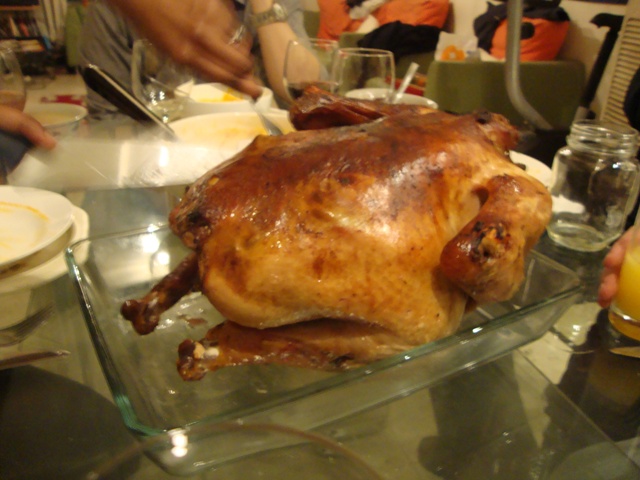
The most expensive bird I've ever eaten.

It wasn’t the best turkey ever, but it wasn’t dry or rock-hard, either. To be fair, it tastes pretty good now, as leftovers. Then again, Thanksgiving leftovers always taste better than they taste fresh.

The full menu: oven-roasted turkey; chestnut mushroom stuffing; tomato bisque with fennel; mustard green beans with ham; mashed sweet potatoes; pumpkin bread; and pumpkin maple pots de creme for dessert. Aside from my tiny oven, Thanksgiving dinner was relatively easy to make. Chestnuts, mushrooms, green beans and sweet potatoes are all hugely popular ingredients in China (chestnuts and sweet potatoes are ubiquitous street snacks). Pumpkins are also sold at most markets, though I just bought imported canned pumpkin. Given how difficult it is to find some staple Western ingredients, I was pretty relieved by how little hassle it was to make all my usual Thanksgiving dishes.

There was just one thing missing: cranberries. Nobody carried fresh cranberries, so I had to serve canned cranberry sauce. Ew! Still, dinner was an overall success, and I had as much fun preparing for it as I did eating it with friends — six people total, including myself, from the U.S., England, Canada and China. Just spreading the joy…

Click through for some pictures. Continue reading