OK, not my Wal-mart. That would be too cool to see.
This is apropos of nothing.
Coming from a background of both journalism and political science, I am still completely bewildered by how there is so much misinformation out there concerning our political (i.e., social) affairs. I rant a lot about how the Chinese government and media are so adept at muddling facts that it’s almost second nature not to know anything concrete here in the land of cha bu duo and where everything can be right at the same time.
But this, from the New Yorker, reminds me of the U.S.’s own muddy information battleground:
Paradoxically, the very things that made the stimulus more effective economically may have made it less popular politically. For instance, because research has shown that lump-sum tax refunds get hoarded rather than spent, the government decided not to give individuals their tax cuts all at once, instead refunding a little on each paycheck. The tactic was successful at increasing consumer demand, but it had a big political cost: many voters never noticed that they were getting a tax cut.
My problem isn’t with the stimulus, which I know little about (though from what I’ve read about it, it’s been neutral at worst.) My problem is this: In a country that prides itself as being one of the most educated and most inclined toward rationality in the world, how the hell can something proven effective and to be working NOT be politically popular? Or, why are most people so hostile toward something that, at the very least, was more good than bad?
I know, I know: It’s spin. Politicians (on both sides, but especially sinister GOPers) love to jump on half-truths and misconceptions, twisting facts around until nothing constructive can come of them — all to gain cheap political points from a public that believes it has never been more informed, which actually has never been more misled. People are spinning spin and spin that’s already been spun. Meanwhile, everyone’s complaining about the media, how it’s so biased and uninformative. If people would just read articles written by real journalists and experts and not just listen to pundits, maybe they would get a picture of a more nuanced reality.
Journalism schools are (rightly) focusing on training students to find new, better ways to package information in today’s faster, more technologically driven, cluttered world. What they should also teach (and, more importantly, figure out) is how to compete with all the punditry and misinformation being spewed.
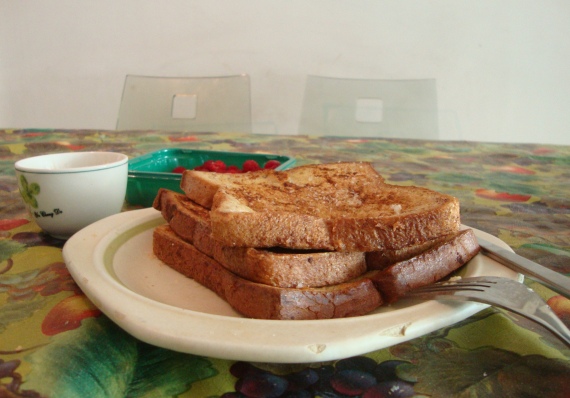
Main ingredients: Bread, milk, cinnamon.
Special flavorings: Honey, which usually sells for 25 RMB ($3.71) for a jar. While it’s comparable to U.S. prices and doesn’t seem very expensive, I do live in a country where things are usually a small fraction of American prices. Still, it’s better than using maple syrup, which goes for 60 RMB ($8.92) here. But, I’m still working on my Jew honey.
Total cost: 7 RMB ($1.04) for eight pieces.
Ever since I saw the preview for the Pixar movie, I’ve always wanted to eat ratatouille. Not that the movie really explained what it is, but I came away with the impression it was some sort of lame, poor-man’s vegetable stew/soup that is undergoing a rediscovery. Vegetables — good! Then I started to look at recipes and realized ratatouille involves eggplant.
Ew.
I decided that I would just … omit … the eggplant, but when I was at the store, I got this feeling that I can’t just omit it. After all, as I’ve grown up and moved out of my parents’ house, I’ve realized that sometimes, you just gotta cook with things you always pick out of your food (I’m looking at you, garlic and green onions). But then, after all the vegetables were roasted and mixed together, I couldn’t even tell which ones were the eggplant! Inwardly panicking, I decided I would just … not chew … anything. Which was hard to do.
Alas, whether the end product is ratatouille or not, it tasted great, so I managed to calm down enough to enjoy it. We ate it with pasta and on its own, and I’m going to try the leftovers with some bread later.
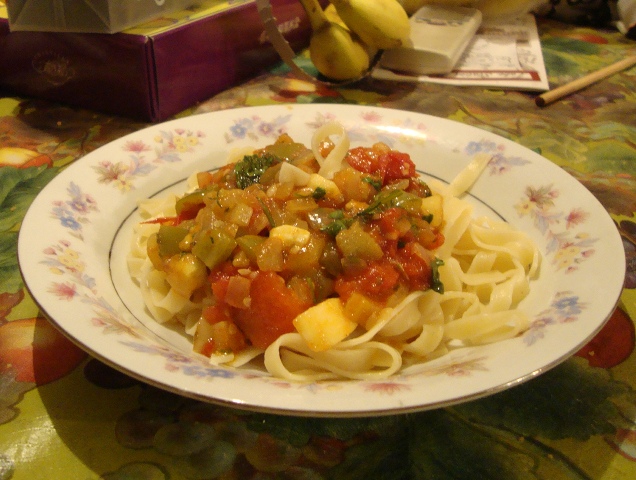
Main ingredients: eggplant :( , tomatoes, bell peppers.
Chinese twist: Instead of yellow squash, which doesn’t exist in China, I used some kind of Chinese squash that kind of is like a fat light green zucchini? Also, instead of normal American herbs, like thyme, basil and parsley, which also don’t exist in China, I used fennel (or something like a cross between fennel and dill) and cilantro.
Total cost: 13 RMB ($1.92) for about six servings. It IS a poor-man’s dish.
Hachis Parmentier is, apparently, the French version of shepherd’s pie, that I baked in my mini-loaf pans:
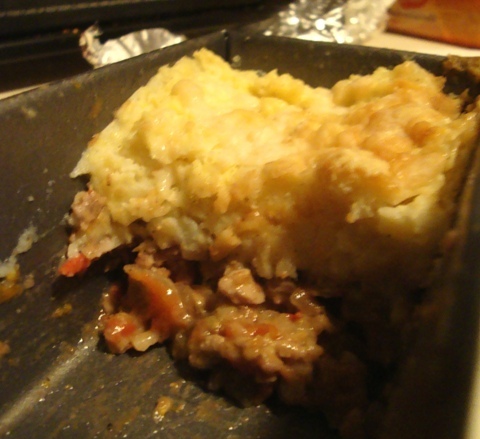
Pretty delicious, though nothing memorable. Nothing especially French about it, either. So, meh.
Main ingredients: ground beef, onions, tomatoes, potatoes, parmesan.
Special flavorings: nothing special.
Total cost: 40 RMB ($5.91) for six servings. Yeah, pricey. For shepherd’s pie.
We had a lot of lettuce leftover from the hamburgers, so naturally, we used it for a salad. (Is there anything else you can make with lettuce?) I used to make this kind of salad a lot at home because it was easy, cheap and delicious, so I don’t know why I never tried to make it here. It was still easy and delicious, and kind of cheap.
Anyway, the point is, I had to make the croutons for this salad. Everything (such as the balsamic vinegar and parmesan) can be found at Carrefour, but not croutons. And I love croutons — a lot. I’ll pour an entire bag on a salad. Actually, I pour half the bag and reserve the rest for munching. Luckily, I had most of a baguette on hand, so my clever mind instantly decided that it can’t be that hard to make croutons. They’re just over-toasted bread cubes, no?
So I cut my baguette into cubes, tossed them in a bowl with garlic powder and dried sage powder (which I think belonged to one of my old roommates, but I’ve been using ever since I moved in — free stuff!) and a little bit of grated parmesan, then drizzled a little bit of olive oil on them to coat them. I spread them out on my tiny baking sheet and toasted them until they came out like croutons. Tasty! Now I want to experiment with all different kinds of breads and herb spices. Of course, they only make about two different kinds of breads in China, wheat and white. Maybe I can use mantou (steamed rice bread) to make croutons with Chinese characteristics?
Anyway, the salad:
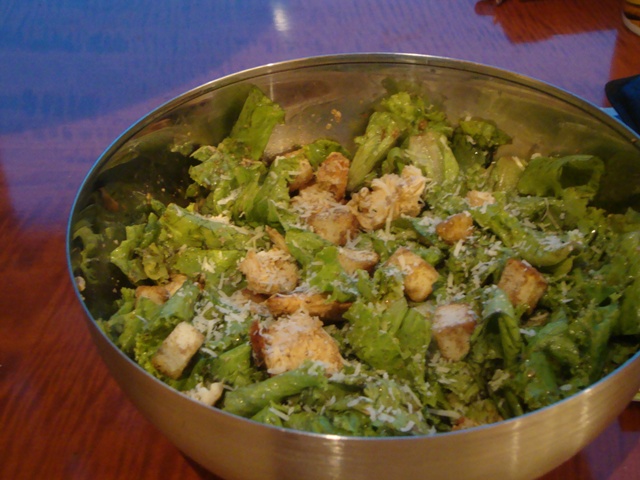
Main ingredients: lettuce, chicken, parmesan, croutons.
Special flavorings: balsamic vinegar, olive oil.
Total cost: about 25 RMB ($3.69). A liter of the cheapest evoo is something like 70 kuai ($10.32), and most of what I see in the supermarket comes from Spain. Balsamic vinegar and parmesan are even more outrageously expensive.
You’ve probably seen the article on how language might influence the way we approach the world in this past weekend’s New York Times Magazine. Basically, it said our mother tongue forces us to pay attention to certain details based on the way it is used. For example, as anyone who has ever learned a European language knows, many languages assign genders to objects, forcing speakers to think about an object’s “gender,” even if it doesn’t actually have one. It also even mentioned how Chinese doesn’t have verb tenses (though I sort of disagree with the author on that), so speakers are not forced to think about time.
The article seemed intuitive — how can language not affect the way we think? — but also points out that very little scientific research has been done on exactly how it does. In other words, no one really knows how our native language has shaped what we think or what it might mean for the greater world society. But it does reinforce my long held belief (and I use “belief” because I have done zero academic research on this and am basing it purely on my observations and limited knowledge of English and Chinese) that learning Chinese can really help to understand Chinese culture and way of thinking.
My main example is this: One of the biggest differences between English and Chinese I’ve noticed is the Chinese dependence on what in English is called passive construction. I only notice this because in writing lessons, teachers drill into my head to “use active voice!” — in English, it is more engaging, less vague and less wordy than passive voice. The “less vague” argument is the most important reason, as it makes the actor — which happens to be the subject in an active-voice sentence — clear. By using the passive voice, the speaker or writer can obscure who or what is responsible for the action, placing emphasis instead on what is going on (the topic). In other words, active voice requires speakers and listeners to think about who is doing the action, which in passive construction takes a backseat and can even be ignored altogether.
Chinese is a very topic-based language. In everyday speak, sentences are often passively constructed. I wonder if this has anything to do with the many times I have had to take out something like “It is said that … ” or something “has been” something’d (found/discovered/confirmed/etc.). It is rare that the “who” is identified. Unlike in English, it is more important — at least, according to the language — to know what is being said/found/etc. than who said/found it.
To make a long story short, it would be interesting to see if this emphasis on topic and less on actor might affect the way the Chinese think. Might this explain why they seem so (for lack of better word) passive? Reluctant to take/assign responsibility? Why concrete, reliable information seems so hard to obtain?
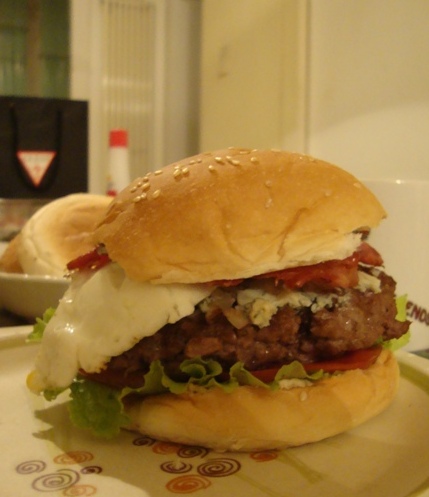
My boyfriend got it into his head that he wanted to be like Rocky and eat Rocky hamburgers, which are big manly burgers that clog your arteries just by being thought of. Basically, we made hamburger patties (fried in a pan, not grilled, because we don’t have a grill), then piled on all sorts of things. We had the requisite lettuce and sliced tomatoes, plus onions, bacon, fried eggs, blue cheese, and bad guacamole. Also, I think that everyone should season their hamburger patties with cinnamon and nutmeg. It really adds a subtle twist.
Main ingredients: ground beef, lettuce, tomatoes were readily available. But I had to go to the Western food market for decent (though still not great) hamburger buns, and while I was there, I thought I’d pick up better cheese.
Special flavorings: bacon, eggs and the jar of guacamole also are all easy to find. And now that I have them, we spiced our hamburger patties with nutmeg and cinnamon, which is highly recommended if you want to add an interesting, subtle kick to your hamburgers.
Total cost: 50 — 55 RMB ($8.10) for four hamburgers. Not too bad, considering one of them alone at a restaurant would cost at least 80 kuai ($11.80).
I was in a soup mood, but this gazpacho was a salad. Although, I’ve never had gazpacho as a soup or salad, so what do I care? I thought the recipe looked really interesting, to eat and to make. And then it turned out to be really easy to make and the best salad I’ve ever made. It was the perfect balance between healthy (fresh vegetables!) and unhealthy (eggs and lots of ham!). My boyfriend — who’s now back from Shanghai :) — gobbled it up, although I think he was just really hungry after an 11-hour train ride.
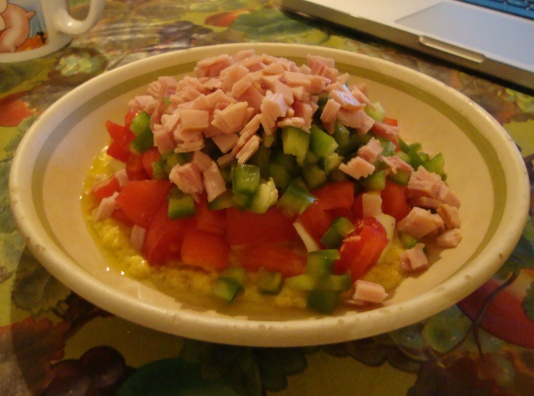
Main ingredients: Tomatoes, green pepper, proscuitto, eggs. All found at Carrefour.
Special flavorings: The recipe called for Sherry vinegar, which I wasn’t even going to bother to look for. Instead, I substituted rice wine vinegar, which I, like a good Chinese cook, already had.
Total cost: Not more than 30 RMB ($4.41) for two big servings. The proscuitto made up for the bulk of the cost, at 21 RMB ($3.09), for more than the recipe called for.