
This gecko scared the bejeezus out of me yesterday morning, darting across our bedroom floor right as I came out of the bathroom. Because who expects to see a gecko in Beijing? I hope I didn’t bring it back with me from Bali. Or Thailand! Anyway, Lizzy was caught (in that dirty takeway container, sorry) and released outside. I hope she is doing OK.
Beijing bans indoor smoking
Finally, a ban I can get on board with!
People are no longer allowed to smoke in indoor public spaces — restaurants, malls, office buildings, etc. etc. etc. I’ve heard that “indoor” means anything covered by a roof.
But wait! Isn’t indoor smoking already banned? Well, it was, but then it was unbanned.
But wait! Didn’t China ban it again? Yes, it did. But that law, national in scope, went into effect four whole years ago and was promptly forgotten. I’m more optimistic (cautiously) about this one, though, because:
- It’s a local, Beijing-only law. Local governments are much more willing to enforce their own regulations, obviously because they fit such local government’s agenda more than national laws do. In this case, Beijing is determined to become a world capital, so adopting a smoking standard on par with other major international cities is only logical.
- It’s backed by enforcement measures. While it remains to be seen how and to what extent the ban will be implemented, at least sanctions have been spelled out. Individual violators face a 200 kuai ($32) fine, which doesn’t sound like much until you realize that amount can buy about five decent meals or a week’s worth of groceries to feed an entire household. Also, the previous fine was only a mythical 10 kuai, so you could say the fine has increased twenty-fold. Businesses — which are responsible for ensuring compliance — can be fined up to 10,000 kuai ($1,600), and repeat offenders can even have their business license revoked. There’s even a WeChat account for reporting violations.
- There’s quite a bit of hype about it. In addition to launching the WeChat account, authorities, with the World Health Organization’s help, have been campaigning for the past 1.5 months to raise awareness about the dangers of smoking and secondhand smoke.
- China raised the cigarette tax from 5 percent to 11 percent. The state’s tobacco monopoly is a powerful cash cow whose goals are, you could say, at odds with those of public health officials, so this substantial tax increase may be the biggest sign that China — not just Beijing — is serious about curbing smoking.
- I just really want it to be true. Man, I’m so tired of smelling cigarette smoke. My Chinese dream is that this ban is only a stepping stone to a ban on smoking in all public places, indoor or not. I can’t tell you how many times I’ve had to stop walking or run ahead or hold my breath while walking down the street because someone was smoking. I generally tolerate it (you have to in China), but Chinese cigarettes can be absurdly strong and smoky. What’s the point of complaining about air pollution if you’re just going to smoke or breathe in someone else’s smoke?
For more on bans in China, see here, here and here.
Pandas

Man, pandas. Is there any other creature in this world that is so bad at life?
First, they let people destroy their homes.
Then, they give zero fucks about repopulating their species (except for this guy).
Now, it turns out they haven’t even bothered to learn, after 2 million years, to digest the very food they’ve chosen as their dietary staple.
What’s your problem, panda? Why are you too lazy to live?

Let’s talk about WeChat
WeChat is the most popular — by far — instant messaging app* in China. Everybody and their grandma has it. Got a smartphone? Got WeChat. Don’t got a smartphone? Still got WeChat. Yeah, I had WeChat before I even got my iPhone. It currently has 500 million monthly active users, most of them in — you guessed it — mainland China. For reference, WhatsApp has 700 million MAUs, while Facebook Messenger has 600 million. I don’t use the former, and the latter is blocked in China.
Obviously, then, I can’t compare these apps, so I can’t say which is better or worse. My understanding, though, is that WeChat is sort of like WhatsApp, Facebook, Snapchat, Vine, Tinder, Venmo, everything, all rolled into one and has far and away the most features. You can play games and buy things straight from the app, transfer money and documents to friends, and all that jazz. It is the little messaging app that could.
But as I’m hardly the social technology type, I am a bit confused about all the functions of WeChat. I just know that when I do use it, I have to go looking for all the functions because the app is really counter-intuitive. Maybe I am not thinking like a Chinese. I don’t know! But please, why?
A bright idea for urban China
Say yes to The Eight Principles for Building People-Friendly Cities (archived page). Starting now. Please?

Hangzhou
Boyfriend and I took a semi-impromptu trip down to Hangzhou (杭州) last weekend during the Qingming holiday. We had discussed going two weeks before but didn’t actually get around to booking train tickets and hotel until just a few days before we left. As such, the trains were nearly all sold out and most hotels fully booked. Luckily we managed to get a train leaving Saturday morning, but ended up having to stay at a pricier hotel and return via Shanghai. We even had to take business class on the Shanghai leg! (Business class was really nice, so I’m not complaining.)
Anyway, Hangzhou is the capital of Zhejiang province, and located about an hour by train from Shanghai. It is famous in China for being idyllic – lush and green, mild in temperature, serene. For the most part, except for the tourists and traffic, that was all true. That image of the city most likely stems from its iconic West Lake (西湖, Xi Hu, above) and Longjing (龙井, “Dragon Well”) tea fields, both of which we visited.

We also went to the Xixi Wetlands Park, which is massive and a great place to get lost in. We unfortunately only had about three hours to spend there and we didn’t see many birds, so I’m not sure I got my RMB 80’s worth of the admission ticket. But it was one of the better national tourist sites I’ve been to in China.
More pictures after the jump! Continue reading

Net neutrality and China: A case study
Guys, the FCC is going to rule on net neutrality one month from now. I don’t need to tell you how important this is. (Unless I do, in which case, see here and here. I won’t link to any arguments against it, because there aren’t any good ones.)
The Republican House and Senate have both introduced bills to preempt the FCC’s vote by removing its ability to even regulate ISPs and enforce a neutral Internet.
But how can anyone be in favor of a non-neutral Internet?
Right now, there are people in this world who have no access to the Internet. They exist in impoverished, rural areas, the places where we would like to think would benefit the most from the single greatest collection of knowledge ever created in human history.
In other parts of the world, people have access to the Internet, and they can (mostly) freely access any content — be it today’s weather, Wikipedia or torture porn — at the exact same speed.
And then there is China. Continue reading
My name, now renderable in emoticons
I woke up (was woken up) very early this morning by the rest of my family texting back and forth. Normally I would have been pretty annoyed, but:
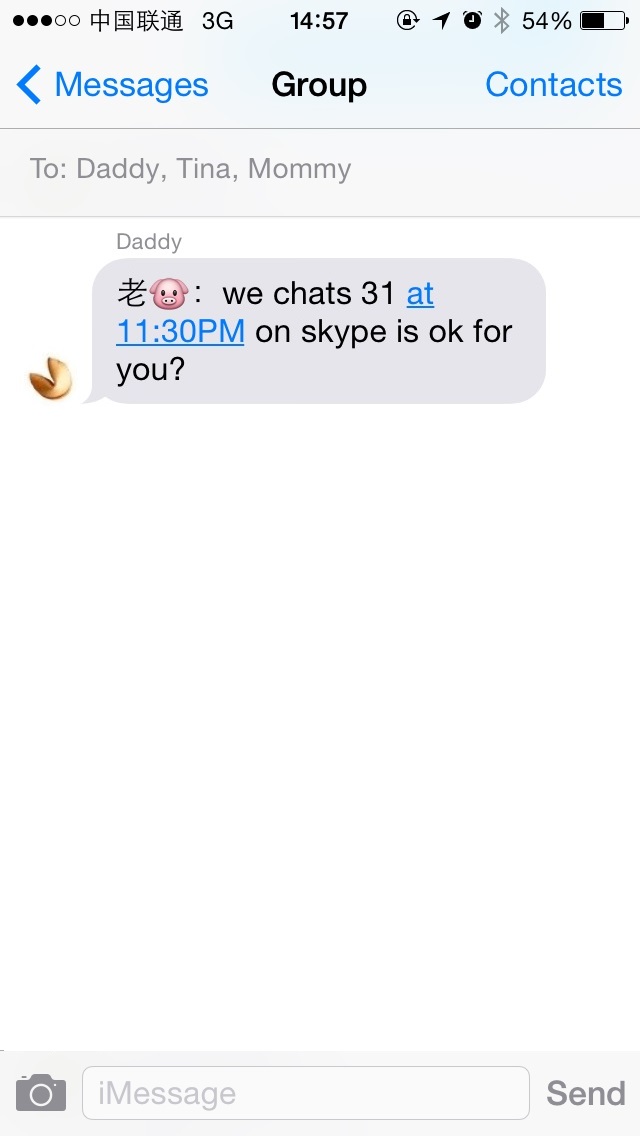
For those of you who can’t read Chinese or emoticons, the first two characters say: Lao Zhu, or Old Pig. That’s me. I am Lao Zhu (Old Pig).
One of my earliest childhood memories is of the time when I was about 3 (I am 3 in all of my earliest childhood memories, though I have no idea if I was actually 3). We were all at my grandparents’ house, and I had wandered into the dining area where the TV was playing Journey to the West (maybe the classic 1986 CCTV adaptation??). Journey to the West is one of the four great classical novels in Chinese literature, the one about the Monkey King who goes west, which is India, to help a monk bring some original Buddhist scriptures back to China. Monkey King and the monk are accompanied by Lao Zhu, whose real name is Zhu Bajie. Zhu Bajie is half-pig, half-man (no bear) and described as lazy, greedy and super lustful of women. (Seriously, one time, he disguised himself as a monk to bathe with a bunch of chicks he came across in a pond, then changed into a fish to swim between their legs. His lust is also what got him kicked out of heaven). He is also disproportionately vain relative to his actual looks and abilities. And there’s this from his Wikipedia page:
In the original Chinese novel, he is often called dāizi (呆子), meaning “idiot”. Sun Wukong [Monkey King], Xuanzang [the monk] and even the author consistently refers to him as “the idiot” over the course of the story.
You can even refer to someone as a Zhu Bajie to mean that he’s dumb and unaware of it (probably because of his vanity). Basically, he really isn’t the best of characters. But for some reason, whatever he was doing on the TV at the time I wandered into the dining room really spoke to me. I can’t say what it is I saw that I identified with, but he is actually meant to (and does, in Chinese culture) represent the ordinary man. Despite his faults, he is still kind-hearted and a loyal sidekick. And he’s a funny character.
I asked my parents what was Lao Zhu. I don’t remember their answer, but it worked for me, so then I asked them to call me Lao Zhu as my nickname. I think they laughed a bit, but ever the spoiled one, I got what I wanted.
Happy New Year! I’ll be watching the ball drop later via Skype with my parents.
Happy China-versary to me!
I got hit by a car yesterday.
Before you panic, I am OK! I am OK because, while the car drove into me, it was going, like, 5 miles an hour? It kind of hit my purse first, which I was holding down by my side, and then all of a sudden I felt this nudge on my leg. I turned around and saw the corner of the front bumper of some sandy-colored Buick. It was really confusing at first, and the driver literally froze in his tracks. He waited until I had walked on some distance, then slowly drove past me, keeping a wide berth as he passed. I thought about snapping a picture of his license plate, but … meh.
Anyway, the incident got me thinking: It took five whole years to get hit by a car. I’ve been threatened by asshole drivers who pull up within millimeters of my body because they couldn’t wait for a pedestrian to finish crossing the road. I’ve been hit by side mirrors of drivers trying to squeeze past me in some tight space instead of waiting for me to pass. But to be actually driven into for no reason! Then I realized that — wow — it actually has been five years. Or just four days shy.
I landed in this glorious shithole on the frigid night of Dec. 14, 2009. The next five years flew by. The end.
(Haha, just kidding, I’ll keep bloggin, yo.)
Banned in China: An update
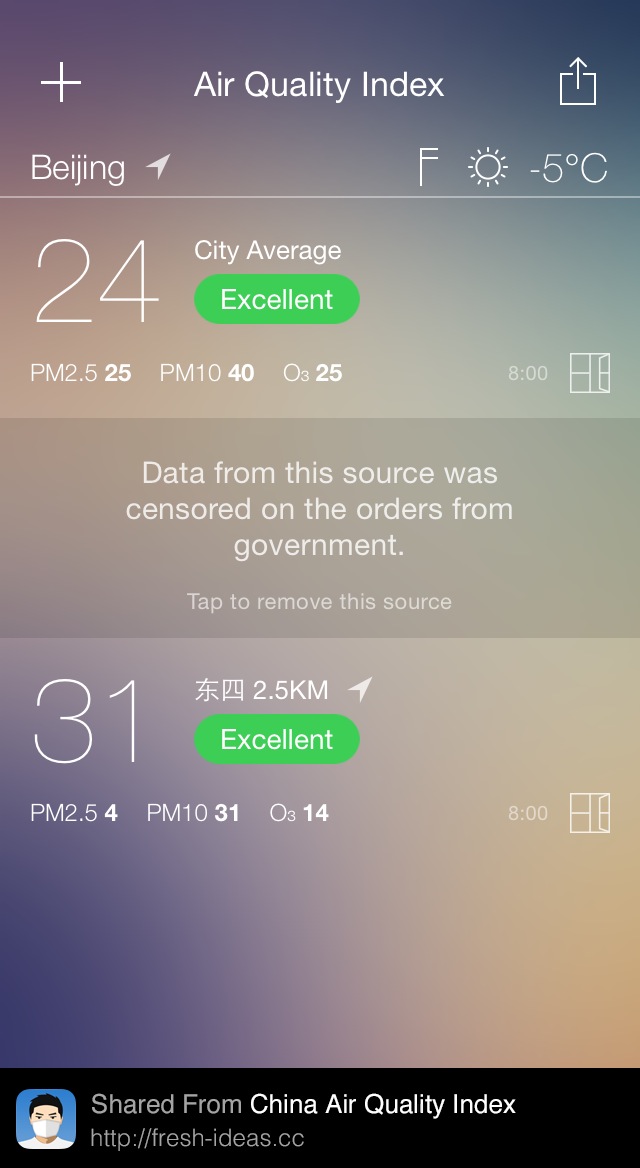 Some things the CCP has sought to ban recently:
- The U.S. Embassy’s AQI readings
- Puns
- The term diaosi
The last two are yet another example of the Xi-led CCP (the XiCP?) crackdown on the culture of today’s society. Even some of the most lovable aspects of Chinese culture are not safe from the CCP, even as officials have some kind of obsession with promoting Chinese culture. A Chinese culture that has been sterilized and stamped and sealed with their approval, that is.
Sometimes the CCP’s ridiculous policies can be so ridiculous that they’re amusing, but other times their ridiculousness just makes you feel a little :(