Beijing Burgers: They do exist!

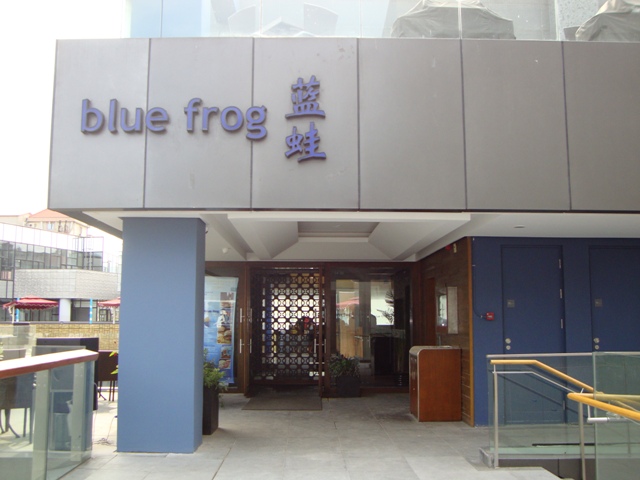
Blue Frog Beijing at The Village in Sanlitun.

Blue Frog is known for its hamburgers, but this restaurant looks far from any meat-lover’s paradise that I knew of back home. Instead, it had the trendy vibe of being a cafe by day and bar by night. When we arrived, there were people sipping juices from tall glasses, engaged in deep conversations or busy on their laptops. And really, there’s nothing trendy about hamburgers, but Blue Frog certainly gives the impression that it will make you a nice-looking one.

One thing the people at Blue Frog are big on is consistency: Much like any other chain, a Blue Frog burger in Beijing will taste like a Blue Frog burger in Macau. I can’t verify this with my own taste buds, but they did sound committed to the concept.
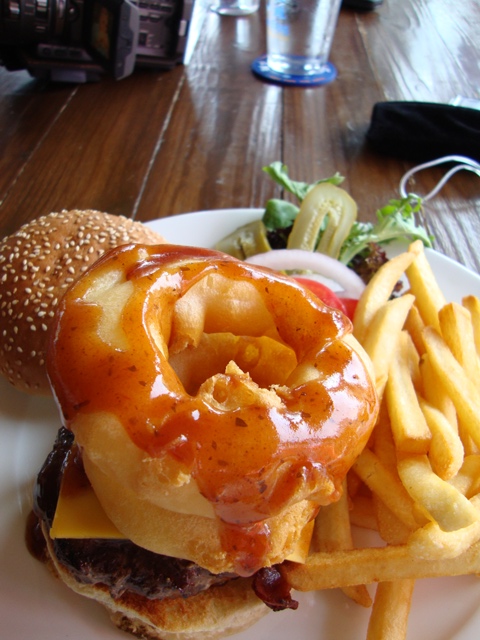
The Montana BBQ burger: try fitting that in your mouth.

Another thing they emphasized was comfort food. They were all about providing that back-home feeling, and man, did their Montana BBQ burger send me back home. I felt like I was in Montana — I’ve never been, but based on this burger, I think it has something to do with onions, bacon and barbecue. That’s not to say it was a bad burger; it credits Montana because the boss is from there.

Bottom line: It was a really tasty burger. For more on what it was like, here is Part 1 in a series I’m doing with Chris on our quest to find American hamburgers in Beijing.

The economy of beer

Chinese beer has its fair share of critics (loaded with preservatives, bland, low alcohol content, etc.), but what are the alternatives? It’s either no beer or expensive imports. But Chinese beer also has a really weird pricing system that doesn’t seem to be governed by a normal market economy. Here is what you can expect to pay:

  • 40+ kuai (~$7), small bottle: Tourist-frequented bars, like those along Sanlitun Lu. Not worth it because a) pay just a few yuan more, and you can get a good import; and b) there’s probably a place selling a big bottle for 3 kuai just around the corner.
  • 30 kuai (~$5), big bottle: fancier and/or tourist-y restaurants. If you’re splurging already, then you might as well splurge on beer, too.
  • 20 kuai (~$3), big bottle: above-average restaurants. Not a great deal, but not especially bad, either. Here, it just depends on whether you want to pay an extra 20, and the answer is usually no.
  • 20 kuai (~$3), small bottle: low-key, high-gravity bars and clubs; worth it for the company you keep at the bars and clubs.
  • 10 to 15 kuai (~$1.50 to $2.50), big bottle: restaurants; depends on how badly you want a beer with your meal.
  • 3 kuai (~50 cents), big bottle: standard at hutong restaurants and roadside vendors. Definitely worth it to go with your chuan.
  • 2.50 kuai (~35 cents), draft: found in a hutong restaurant near our work.
  • 2.50 kuai (~35 cents), big bottle: small store right outside our apartment; bring back the bottles (which is sent back to the bottling place to be reused), and you get 5 mao back. Which means, the cheapest beer we’ve found in Beijing is less than 30 cents for 600 milliliters. Conveniently, it takes less time than a song to go to the store, buy a bottle and return to the apartment.

Anyway, there’s a beer festival going on somewhere near our colleague’s house. I am obviously off to find it so I can perhaps try out some different (dark) beers. Not now — it’s only 9 in the morning.

Chinese opinion pieces

Here is an example of a routine polishing job:

Democracy and freedom, as essential elements of a modern civil society, have already been recognized by the Chinese government…

Recognized, though apparently not put into practice. But a little recognition can go a long way.

At any rate, the piece it comes from was written by a lecturer at Beijing University of Chemical Technology on Rebiya Kadeer.

The most frustrating thing about work is the amount of misinformation and lack of clarity in many of the stories being put out by my company. Many of the people we work with are not journalists, just translators; and I am just polishing, not editing.

Xinjiang riots: Stop missing the point

First, comparisons to last year’s riots (“protests”) in Tibet focused on the media’s bias in naming the incidents, which led to speculation that discrepencies in reporting may be because Tibetans are peaceful Buddhists and Uyghurs are Muslims.

Now, Glenn Greenwald is lamenting that if only Uyghurs were Christian, the Chinese government would be much more easily undermined.

What the hell? Any ethnic tension that explodes into violence undermines the Chinese government, not least of all because social stability is the main tenet of Chinese governance from which the Party derives its legitimacy. Forget comparisons to last year’s Tibet riots. Perhaps differences in coverage do point to a subtle bias in Western media and/or society. But achieving sympathetic parity for any oppositional group in China is the least anybody in the East or West should be worried about. Continue reading

A day at the park

China.org.cn sent me over to the Olympic Green last Wednesday for free. Impressions:

  • The Bird’s Nest seems really small from the inside. The track and field were covered up from the concert the night before, so it was hard to imagine how they fit 10,000 athletes on it.
  • The Water Cube is the cutest little building. I love their chairs.
  • The Green is gorgeous at night when the buildings are all lit up.
  • There needs to be more restaurants surrounding the gigantic block.
  • China is not ready for Western-style performing arts. They were largely unimpressed with the Swan Lake “ballet” at the Water Cube, with the silly clapping at the end and diabolo performance in the middle.

More in this story I wrote. Pictures in the photo gallery. Clips from Swan Lake at the Water Cube.

International Food: Russian

Perhaps you’ve noticed a random picture of what is supposed to be beef stroganoff in the picture gallery. It was taken last Saturday after Chris and I wandered around the Russian part of town in search of the Shard Shop. We never found it, but hungry and exhausted from a late night/early morning, we found Chocolate. Their nest-like swings won us over, and we quickly nestled in them.

Chocolate is a night club/restaurant, and as heard around the blogosphere, it’s a pretty swank place to go at night. Its over-the-top decor (probably hinted at with the nest swings) of chandeliers and velvet chairs makes it seem gaudy — but it wants to be and even makes it a good thing. Anyway, I only had the beef stroganoff and an 80-yuan bottle of pineapple juice. They did bring us some ice in a bucket, though.

I’ve never actually had beef stroganoff before, except for what I make. The beef was sauteed with onions and mushrooms, which I love, and it was definitely shredded — so props to them on that. But the sauce was a weird orange color and a bit thick for my liking. Instead of sour cream, it seemed like just cream, and it just overwhelmed the beef-onion-mushroom flavors. I was really glad it came in a bread bowl so I could soak up some of the sauce with it. It didn’t help that it cost 40 kuai, either.

I wish I had tried something else on the menu, which offered things I’ve never heard of and can’t really remember. They were all misspelled Russian foods, but I have a feeling that anything I ordered would have been only subpar.