That time when China hosted an Internet conference

Not quite content with the extravagance of hosting APEC, China went on to host its first World Internet Conference in Wuzhen, a coastal city near Shanghai.

How ironic is hosting a world Internet conference in a land where the Internet is blocked, blocked and blocked?

How ironic is it that China had to unblock the Internet in the city that hosted the event? And then restricted access into the city? If you can’t restrict access virtually, you can still do it physically, I guess.

I mean, how ironic is it that China delivered its would-be Internet declaration by hand, instead of by Internet, the very tool they were just talking about?

The CCP wants to play a bigger role in the development of the Internet, and it is proposing an open Internet that follows rules, which — apart from being a contradiction in our world — is just a thinly veiled way of saying it wants to censor the fuck out of it. And other countries could, you know, do it too. Yeah! Come on, guys! says the CCP.

Seriously, why would anyone take an Internet conference in China seriously? Oh, no one does. That declaration, meant to be officially released at the closing ceremony, never was. CCP ideals and Internet ideals just don’t compute.

How terrible a place is Beijing?

Judging by the lengths the government is going to make Beijing a “nice” place — pretty terrible! Here are some emergency measures being taken to turn this city around for the two weeks APEC will be in town:

  • Pollution: Government officials have promised nice air for APEC, by closing factories and kicking people out of the city. Drivers both inside the city and in the surrounding provinces are also being forced off the road.
  • Food safety: Hotels receiving APEC attendees must source their food from a list of 20 government-approved vendors.
  • Traffic: The government is restricting cars on the road by alternating the days on which cars with even- and odd-numbered plates can drive. Moreover, public schools and “non-important” government offices (such as the marriage bureau and visa office) were ordered to close from today to Wednesday of next week, with make-up days this past Sunday and the following Saturday. Private schools were “encouraged” (i.e. forced) to voluntarily close, and companies and other institutions were asked to allow employees to work from home those days. Even hospitals will be closed.
  • Security: Security checks have been ramped up at the airport and subway and around the city. According to Boyfriend, the subway has introduced bins, similar to the ones used at airports, for people to put their belongings in for the bag scan, and security no longer allows people to breeze on through with their bags open for a nominal security glance-check to see what’s inside — regardless of how much you scream and yell. I wonder if the scan checkers actually look at the screens now.
  • Press freedom: At the media center, not only can you get an overdose of Chinese culture, but also access to famous banned websites, such as Google and Facebook.
  • Protestors and small business owners and other “undesirables”: Who?

Why is the Chinese government going through all this trouble? Is APEC a big deal? The short answer, for us everyday plebes, is: Not really! But government and business leaders from all the important Asia/Pacific nations will be here. The United States is attending — Obama is coming — as well as Putin and Abbott and Abe. They will talk about cooperating with each, economically, and maybe reach some big deals. So APEC has the potential to be important, but probably not to the point where more normal countries/governments would feel it was OK to disrupt businesses and people’s personal lives just to suit some big shot officials. But this kind of high-level, multinational, all-talk-no-action forum is exactly China’s cup of tea, so it’s practically like the Olympics all over again. It’s even being partially held in the Olympic Park, and they’re planning some kind of fireworks show for APEC.

China’s foreign minister explained China’s goal as such: China wants to host a “harmonious and smooth” APEC that would leave a “deep impression on history”.

This is a forum that is held every year (last year, it was in Bali).

APEC preparations began last week, and true to their word, officials managed to clean the air. Between Friday night and Saturday morning, the AQI had fallen from a high of 274 to a low of 46 by noon. Unfortunately, by Tuesday, on the eve of the first APEC events, the AQI was back up to 305 before dropping back down to healthy levels again for two days. But then again, today, as APEC kicks off in earnest, Beijingers awoke to familiar hazy skies. The AQI was back up to 160 this morning. Someone should get fired.

And despite the government’s efforts to turn Beijing into a wonderful place, there are still some emergency measures not being taken that would go a long way toward improving the city:

  • Ban on sidewalk/street-side parking
  • Ban on honking for no reason
  • Ban on shouting into phones
  • Ban on pushing and shoving and not lining up

Everyone is leaving China

Or so this article claims, rather dramatically.

But I am here to refute that claim.

Because I am not leaving. Oh, no, I am staying put. I’m so staying put that I just signed a lease for two more years. #notalleveryone

In all seriousness, though, the author does have a point. The recent crackdowns on speech and expression are indeed alarming and ominous (and annoying*). But are they really the reason why everyone is leaving? For some people, the attacks may be pushing them toward leaving. But they were probably already considering leaving, because let’s face it: There are a lot of reasons to leave China. This “one-man rule”** is not the reason people are throwing in the towel. They are leaving for a variety of reasons, such as better opportunity elsewhere, looking for a change, pollution, health, being closer to family, natural point in their career to move. You get my gist. One of those reasons for moving could be “freedom,” but it’s more like an incidental benefit to leaving than an actual reason many people are using to leave.

Thing is, this type of claim is always being made, especially over the past three to four years. The government has been fixing its policies, and no, they have not been favorable to expats. It unified the tax system for domestic and foreign companies in 2010, unified the Chinese social insurance contributions system for local and foreign employees in 2011, placed greater restrictions on getting a visa in 2012, made it harder to get a work permit in 2013, and this year placed higher qualification requirements on English teachers. And those are just the policies. So for a lot of people, the benefits — and ease — of living in China are just no longer there. Of course they’re going to leave. But they are leaving for practical reasons, not ideological.

There are also many social reasons (such as the rise in the number of qualified, educated Chinese who want jobs) and cultural reasons (such as how foreigners — no matter their contributions to China — will never be Chinese). Also, if you haven’t heard already, the air here is terrible. Pollution is the reason that middle-class Chinese people leave. (The rich leave because of better education and work opportunities for their children and economic security.)

Lastly, China is a terrible place, but it continues to do well in expat rankings. HSBC just released their annual expat survey, and China placed third, mostly on the strength of its economic benefits. Because despite all those reasons to leave, many people are still able to find reasons (money***) to stay.

* Just as I was about to post, I saw this article about Beijing banning the annual Halloween tradition where a bunch of expats dress up and take a loop on the Line 2 subway. It’s a little silly, but good fun. It certainly isn’t anything dangerous or subversive. But this is more to do with the upcoming APEC summit than speech.

** I don’t even know what she means by “one-man rule.” If she thinks Xi Dada is calling all the shots, she’s kind of not learned a lot in her four years here.

*** In this year’s expat survey, China came in first on the economics front, up from second place last year. Meanwhile, China went from no. 3 to no. 26 in “expat experience”. It seems that HSBC may have revised its methodology, however, so it’s unclear what this sharp decline is about (political ideology was not a metric).

This is in your air, Beijing

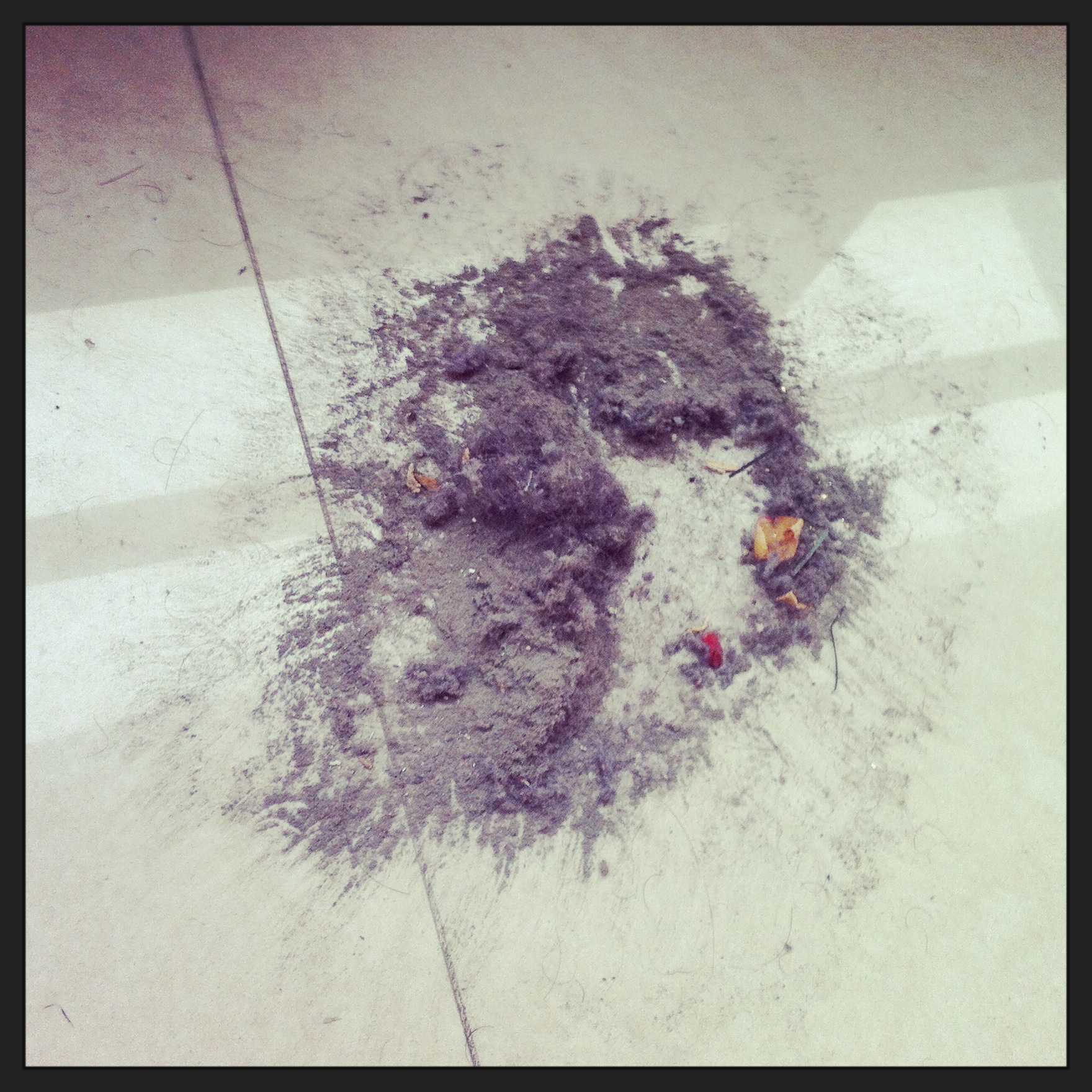
During the summer, we leave our windows open to lessen the pain of baking in a concrete oven. While our apartment becomes cooler, it also becomes dirtier, even though we have screens on our windows and live on the 11th floor. Every week, I sweep up the mess, a dirty affair that takes about an hour.

An hour for a space that is about the size of the average American closet. A space I don’t even actually use.

Eventually I gave up on this losing battle and decided to just wait until the end of summer to do it all at once. It’s not like I ever ventured over there except to clean it. So I ignored it until this past weekend. The mess was pretty horrific:

Sweeping

How gross is that? That is the dust and soot that collected on the floor of our little living room alcove, a space of about 1.5 by 4 meters, in the last month of summer. That stuff floats around in the air of Beijing. We are breathing it! And I let that sit next to my living room. I don’t know what I was thinking. It’s bad enough after just one week; why did I think a whole month would be OK? I’m sorry. Never again.

I hate you, Beijing.

More than you ever wanted to know about the Beijing subway

The Guardian ran a longish piece on the Beijing subway by Tania Branigan. Here are some facts:

It is late summer and the carriages are crammed, but air conditioning keeps it cool, blowing wafts of recently applied deodorant across the crowd.

Who in China, besides foreigners, wears deodorant? According to Boyfriend, one of his coworkers once told him that deodorant smelled funny. Body odor and halitosis are facts of life here. I do not know about this mythical subway carriage on which Branigan had the good fortune to ride, because the subway stinks and everyone knows it.

“The subway is the pride of Beijing. It’s the only reason to live in this city,” says Liu Jinchang, a sales director, over one shoulder, since he does not have room to turn. His tone is jokey, his enthusiasm genuine: he has a car but prefers to commute this way because it is faster and easier than driving.

The subway sucks. You are forced to walk miles to a station, more miles to the subway platform, even more miles to transfer to another line, and then miles again when you exit to your station to your final destination. Sure, it’s mostly pretty clean and new and well-run. But subways are supposed to be convenient; the Beijing subway is rarely ever super convenient. The only convenience it offers over driving a car or taking the bus is that it avoids any possibility of traffic congestion, but all of those extra miles you are forced to cover by foot negates this convenience. All that time you might be stuck in traffic is the same amount of time you spend walking to and from the subway. So unless you are going all the way across town between places with a subway station, the Beijing subway actually makes you strongly consider your other transportation options. It sucks. If it’s the pride of Beijing, then Beijing must be a terrible place.

In the next six and a half years, extensions to the Beijing subway will cover more ground than the entire London Underground network has in a century and a half.

Development! But let’s not pretend that a larger system will make the city any better. There’s still this to contend with:

But Jin Xue, an expert on China’s urban development at Aalborg University, is concerned by the growing tendency for cities to sprawl outwards.

“Historically, the urban density of Chinese cities was really high,” she said. “In recent years, [in places], it has been decreasing … Compact and high density cities should still be pursued, not just to preserve farmland, but to reduce traffic volumes.”

Better planning, such as seeking to bring homes and workplaces closer, could reduce long commutes and cut congestion.

I just wish someone in China felt the same way.

On the dairy trail in San Francisco

San Francisco is a food lover’s paradise. With restaurants covering just about every type of cuisine in the world (we had everything from Shaanxi to Scandinavian, from donuts to Vietnamese), it is almost impossible to stop eating, lest you miss out on something special. Ingredients are also usually locally sourced, fresh and organic. While the foodies there can sometimes go a bit overboard (don’t get me started on this four-dollar “artisan” toast), the local obsession with food creates myriad opportunities for excellent dining experiences.

Luckily for me, Beijing also has a pretty diverse range of culinary options, so while in San Francisco I could concentrate on what Beijing doesn’t have or do very well. That includes sushi and Vietnamese, but mainly I’m talking about milk.

As I’ve said before, I love milk. For milk is the basis of many creations that I love: milk and cookies, milkshakes, milk tea with tapioca pearls, yogurt, cream, ice cream, custard, butter, things made with butter, lattes, and of course just plain whole milk. Aside from the ethical concerns of milk production, I love milk enough to make up for my family’s intense dislike of milk. My dad, who loves ice cream and was my constant ice cream companion when I was growing up, claimed to be lactose intolerant and hates cheese. My mom, scarred from the French culinary influences in Vietnam, also hates cheese and has a phobia of custard and custard-like foods. My sister just hates dairy, for no reason, but she’ll try anything labeled as crafty and artisan, so now she is into some cheeses and ice creams (also, beer). Continue reading

San Francisco

It was time to get a new visa, so back to the States I went. The visa run, a time-honored tradition for expats living in China, may seem quite inconvenient, but I love the opportunity to travel on the company’s dime. A free trip home? Why not!

This time, the timing was especially convenient because it gave me a chance to spend some quality time with my sister before she ties the knot in October. Plus I hadn’t been out to see her in San Francisco since I left for China five years ago. (Fun fact: I got my company to book me a flight with a layover in San Francisco, so my sister was the last person I saw before I moved to Beijing.)

(Fun fact: She’s visited me in China three times.)

(Does that make me the bad sister?)

I’ve never been particularly fond of San Francisco; even though it has a rather apparent homeless problem, it’s still too nice for me. I prefer dumpier places — which, come to think of it, is probably why I live in Beijing. I need to see grit, struggle and glamor commingling into chaos. I need that tension. When hipsters and eco-friends super in tune with their minds and bodies have turned everything into a better way of living, it can start to feel bland and artificial. I mean, the homeless in San Francisco have blankets, sleeping bags, cushions and even pets! And the weather is pretty mild all year round. That is nice (for being homeless).

But nice is, well, very nice after living in the wilderness of Beijing for a while (or three months). I won’t lie, I can’t remember much of San Francisco from my last three visits, but this visit has convinced me that it is better than I give it credit for. I will probably even remember some of it now. Good job, SF!

Photo: On the edge of the United States, looking up at Sutro Beach.