I’m going to Korea!

There’s something I never thought I’d say. I don’t have anything against the country, but unlike a lot of Chinese and Chinese-Americans, I never got into Korean food, Korean supermarkets, Korean films and TV shows, Korean cosmetics, or any of the countless other manifestations of Korean culture. I never wanted to study the language, and I never wanted to convert to Christianity.

But Korea is, like, a two-hour flight from Beijing. It’s accessible. It’s influential. And it’s got the fastest average Internet speed in the world. For reference, China is 98th.* Korean culture might not be my thing, but it’s something I’ve become more and more aware of as I’ve lived in China, mostly as I’ve come to realize the effects it has on regional geopolitics. While its presence has always been felt, it is often overshadowed by China and Japan like a neglected middle child, but over the past couple of decades, it has been coming into its own. Korea today seems more like the Japan of the ’80s and ’90s, with an enormous amount of soft power for its size (especially in East Asia), and it is interesting to see bits of Korean culture intermingling with the Chinese lifestyle. I wonder if Chinese influences are as plentiful or noticeable in Korea.

See you in Busan.

* It’s unclear from the survey, but I’m pretty certain China would fall another 100 places if strictly counting browsing speed for foreign websites.

Living with Dead Hearts

Please watch this documentary. It was filmed by an independent husband-and-wife team (the husband being a venerable laowai) and helps to shed light on a Chinese issue that rarely gets any attention: the tens of thousands of Chinese children who are kidnapped each year and their parents who have next to no hope of them ever being found.

One of the kidnapped children in this video is presumed to have been sold into slavery at an illegal brickyard. Anyone who has been to China knows that China is basically made up of bricks and tiles. The sidewalks are made of bricks. Paths are made of bricks. Shop floors are tiles. Their walls are tiles. The plaza outside them are tile-bricks. Apartments are tiled. The danxia national park we went to in Gansu had a lone road weaving through the entire park, made exclusively of bright red brick. Why? Because kidnapped slave children can produce a lot of bricks and tiles for really, really cheap. So cheap that developers can then pay migrant workers a meager salary to lay them wherever they want. The result looks uneven and shoddy, but bricks are abundant and cheap.

Recently, Chinese authorities caught a doctor who had been stealing newborns by telling the parents that their kid was disabled or ill and then selling them on the black market. It is one of the rare cases of actual government action against child traffickers.

An Ode to Honeymoon Dessert

I can’t believe I haven’t written this post earlier. But anyway, if you know me at all, you know that I love dessert. Of all varieties. Like cakes, cupcakes, custards, pies, puddings, and of course, ice cream. Of course, in China, the Western dessert bar is set kind of low, but luckily I love Asian desserts* too. Not so much the shaved ice stuff (poor man’s version of an ice cream sundae), but mochi, egg tarts, tang yuan (glutinous rice balls with or without fillings), red bean soup, green bean soup, soup-y dessert concoctions in general — all deliciously yummy. Westerners tend to either like Asian desserts alright or are really put off by them because of their tendency toward chewiness and lack of variety in flavors. Red bean, green tea, taro, mango and pandan may seem stereotypically Asian, but they also exist in abundance here. So if you don’t really like them, you’re pretty out of luck when it comes to Asian desserts. Luckily, I LOVE most of these flavors. And the chewiness is OK, too.

So there are a lot of Asian-style dessert places here, in Asia. But the best one is Honeymoon Dessert (满记甜品). I love Honeymoon Dessert. It’s probably my favorite place in Asia. Besides having a wonderfully adorable name, it has all the Asian desserts I could ever want, as well as a lot of affordable customizable options. Here is the best thing ever:

What you get when you combine everything you love into one bowl!

It’s mango and black glutinous rice in coconut milk, or what they call a 芒果椰汁黑糯米甜甜 (mango-coconut milk-black rice sweet sweet). To make this trifecta even more perfect, I usually add a serving of tang yuan, because I love tang yuan and an extra serving is only 6 kuai. Boyfriend usually goes for the almond shuang pi nai (双皮奶), a traditional custard-type dessert. It is also very delicious. I’m not moving home until I can take Honeymoon Dessert with me. Honeymoon Dessert is the best, QED.

I felt compelled to write this because boyfriend left his phone there last night, so we have to go back tonight. Well, I don’t have to, but I’m going to, and I can’t wait. Honeymoon Dessert two nights in a row? It’s, like, the best week ever!

* Asian dessert here is the “typical” Asian-style dessert — most of them are relatively recent creations from Hong Kong, Taiwan and Singapore, sometimes with Southeast Asian, Japanese and Korean influences. I am NOT talking about those weird, dry “lao Beijing” or wherever stuff.

Weekend fun: Avocado coconut ice cream

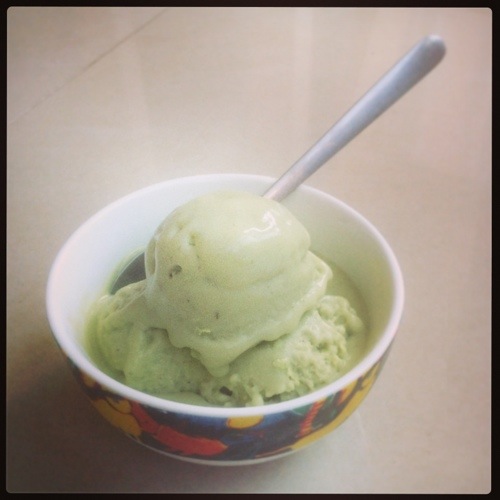
I’m exploring dairy- and citrus-free dessert options for when boyfriend’s dad visits next month. My first experiment, avocado ice cream made with coconut milk, turned out to be a winner. I used David Lebovitz’s recipe, which struck just the right balance between the two really rich flavors of avocado and coconut, resulting in a light but creamy dessert that is perfect for summer. The bowl below was scooped straight from the ice cream maker, which is why it started to melt so quickly.

Avocado as an ice cream.

Beijing place names and history

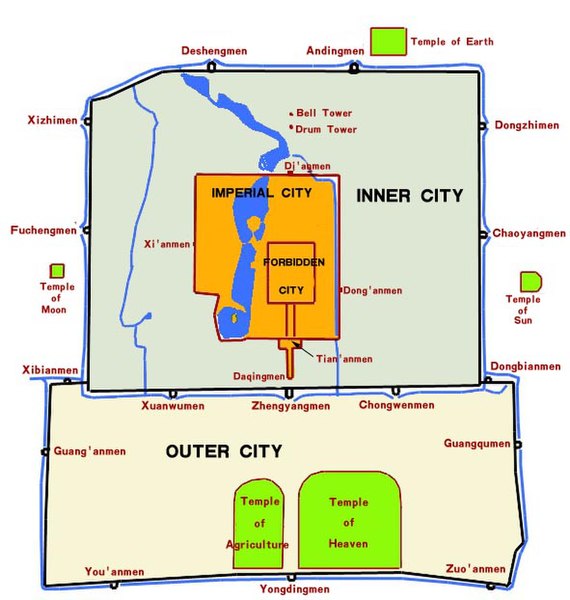
As far as cities go, Beijing is very much a planned one, ever since Kublai Khan defeated the last Song dynasty emperor and established a new capital, Dadu (大都, Grand Capital), in 1271. Of course, Beijing’s history dates back further than that, but much of its modern-day layout has its origins here. Kublai Khan wanted Dadu to be a showcase capital for the Yuan dynasty. Built along a north-south central axis, which still exists today, Kublai Khan gave the city its grid pattern, its central lakes and canals, and its famous hutongs. You can even still notice the symmetry of the city. For example, Dongcheng (东城), Dongsi (东四) and Dongdan (东单) — Eastern City, East Four and East Single — all have their counterparts on the west side of the axis: Xicheng (西城); Xisi (西四) and Xidan (西单), respectively.

After the first Ming emperor established his capital in Nanjing (南京, Southern Capital), he captured Dadu and renamed it Beiping (北平, Northern Peace). Then, at the beginning of the 15th century, the Ming emperor Yongle declared it as the seat of his rule and gave it the name we call it today — Beijing (北京, Northern Capital). Since then, throughout the rest of the Ming dynasty and subsequent Qing dynasty, Beijing has been made to be fit for a king. The Forbidden City, palace retreats and suburban gardens, and many of the landmark temples were constructed under the Yongle emperor or Qing dynasty emperors. The Yongle emperor also erected a city wall, which was razed in the 1960s under Mao Zedong. Today, it is known as the 2nd Ring Road. Portions of the ancient gates remain, which you can see as you drive around the road. Even though most of the gates are no longer there, their former locations now mark the main intersections: Dongzhimen (东直门), Chaoyangmen (朝阳门), Guangqumen (广渠门), Zuo’anmen (左安门), Yongdingmen (永定门), You’anmen (右安门), Guang’anmen (广安门), Fuchengmen (阜成门), Xizhimen (西直门), Deshengmen (德胜门) and Andingmen (安定门). Going further, the streets that intersect the 2nd Ring Road at these former gate points are usually divided into “inner” and “outer” portions — for example, Dongzhimennei (东直门内) and Dongzhimenwai (东直门外) — indicating whether the surrounding areas are either within the city proper or just outside it.

Old Beijing / Wikipedia

Outside the 2nd Ring Road, the city loses its symmetry. Neighborhoods become less defined and more just general areas, and a lot of their names have cun, zhuang or tun at the end. They all roughly mean “village” in English. As such, a lot of well-known places in Beijing — for example, Zhongguancun (中关村), Baijiazhuang (白家庄), and of course, Sanlitun (三里屯) — were all once villages outside the city. As Beijing grew, they got eaten up. These days they are very much urbanized, but their old names have stuck. It took me a long time to realize it, but Sanlitun literally means “village that is 3 li [from the city]”. Li is a unit of measure for distance. I live in Liulitun (六里屯); “liu” is the number six, so you can probably guess how far from the old city I am.

All of this to say, Beijing has a very rich history that is clearly reflected in the names of its neighborhoods, still in use today. The fact that place names usually refer to where they are located within the city also makes it hard to get lost if you know even just a little Chinese. For some people, a place’s name is just a name, like how a person’s name will connote his character, not his name’s actual meaning. But in Beijing, a lot of times, ignoring the meaning of a place’s name risks missing out on the history behind it. Sometimes I forget to stop and think about it. But when I do, I always discover something fascinating about this crazy town.

For more on Beijing’s history, here is a recap (bonus points for even getting a dig in at the Nationalists). Beijing of Dreams also has some really cool old photos of the ancient city gates.

24 hours in Suzhou

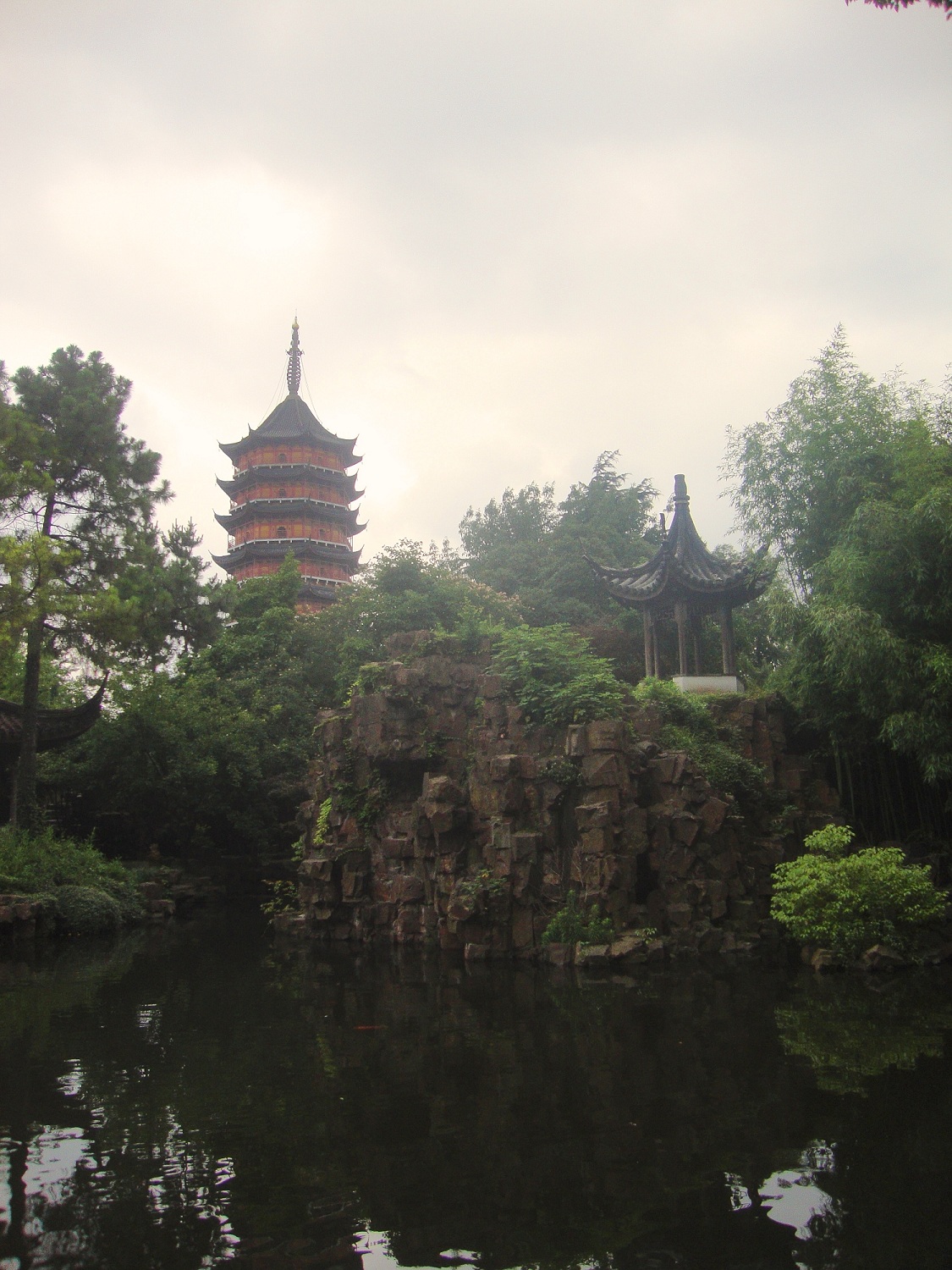
North Temple Pagoda.

This past weekend I took the high-speed train down to Suzhou with a friend. She’d never been and wanted to get one last trip in before she leaves China at the end of the month, and I hadn’t been back since the family vacation tour of 2002. At that time I was a rebellious American teenager shying away from the Chinese part of me, and so what I remember of Suzhou was the canals and relative tranquility of a quaint Chinese town compared to the bustle and modernity of Beijing and Shanghai. Now Suzhou is in the throes of development, which of course means more people and construction everywhere, but it still retains its charm (for now).

Suzhou is located on the southern bank of the Yangtze River, just an hour upstream from Shanghai. From Beijing, it’s five hours south on the high-speed train. The old part of the city was built on a system of canals, and thus it is often compared to Venice. It is also the home of many (many) classical Chinese gardens, some of which are UNESCO World Heritage Sites, and really, if you want to see a Chinese garden at its best, go to any of them in Suzhou. Unfortunately, they all close at 5 p.m., so because it took us so long to settle into our hotel, we only managed to visit two of them on our first day, the North Temple Pagoda (北寺塔, Beisi Ta) and the Humble Administrator’s Garden (拙政园, Zhuo Zheng Yuan). The Humble Administrator’s Garden is one of the four most famous gardens in all of China, as well as the largest in Suzhou, but I’ve never heard of it. It’s also an AAAAA-rated (the highest) tourist spot. This means that the admission price is more expensive and there will be lots of people, including tour groups that crowd around and block everything. I know this is just a fact of China, but it’s especially unfortunate because the gardens are supposed to be quiet, restful places for meditation and harmony with nature.

Continue reading

US v. China: Immigration edition

Immigration is a tricky subject. The U.S. and China, which have not touched their immigration laws since the 1980s, have both tried to tackle this issue recently. The U.S. is notorious for being one of the most difficult countries to get into, which is pretty sad given its legacy as a country built by immigrants. But last week, the Senate managed to pass, with wide support, a comprehensive immigration reform bill that would fortify the southern border, expand and create programs for special work visas, and provide a new path to citizenship. The House may kill the bill, but save for the ridiculous wall, it still offers hope for millions of residents who have been living and working in the U.S. for years, as well as people who still hope to move there.

China faces a different kind of immigration problem. About 5,000 people have permanent resident status in China, and it’s practically impossible to ever become a citizen. Instead, the issue is the influx of foreign visitors and workers who, though here temporarily, often find themselves staying for longer than their visas will allow or for purposes other than their visa is intended for. It is in this context that China’s newly revised Entry-Exit Law goes into effect today. The law has been much talked about among expat circles since it was passed by the National People’s Congress on June 30, 2012, but even a year later, the practical rules — which were to be hammered out by national agencies and local governments — remain vague. Moreover, new requirements are being implemented with little to no notice. For example, last August, the Chinese embassy and consulates in the U.S. began requiring additional documents for tourist visas, such as an invitation letter from a “duly authorized tourism unit”. Having dealt with China for a while now, I have a vague idea of what that is, but the millions of people who have never encountered Chinese bureaucracy were thrown for a loop. At the beginning of the year, it was no longer possible to obtain an F visa through a visa agent — an authorized work unit had to sponsor you. Then, in May, I discovered just a few days before my visa was about to expire that it was no longer possible to even renew or extend a visa beyond a year. The last time I obtained a visa outside of China, in Hong Kong in December 2011, China allowed visas to be extended up to two years. Moreover, visas had to be obtained in a person’s home country. As I said, these new regulations crop up with little warning and are implemented with no grace period for people caught in the middle.

Where the new law isn’t vague is where it imposes harsher sanctions for people who illegally enter, work and/or live, as well as businesses that illegally employ them. In this respect, taken at face value, the law makes total sense. Plenty of people are living and working here on extended tourist and business visas, and as late as March, it was still possible to get a tourist visa in Hong Kong. However, the reason so many people are working here illegally is because it’s damn hard to get a proper work visa. Companies must be authorized to hire foreigners, and depending on the kind of business they are involved in, companies may be restricted to hiring only foreigners with certain qualifications — regardless whether the company believes they are qualified or not. In Beijing, there is also an unpublished policy where companies can only hire a certain number of foreigners, if they can hire any at all. How the authorities determine this number is unknown, but it is likely based on the company’s registered capital and staff size.

This leads me back to my surprise visa run at the end of May, at a point when the new Entry-Exit Law hadn’t come into effect. A few weeks before, word was that starting today, there would be loads of new visa types to complicate things even more. Among them was the M visa for “commercial”-related visits and the R1 and R2 visas for “talented” people. How these differ from the already existing F business visas and Z work visas (for “foreign experts”, among others) is unclear still. And as far as I can tell, there are no details on who can/should apply for them or which companies can offer them. As such, it’s unclear whether the law is actually being implemented or not.

With all the new visa types, it would seem as if China were making it more easy to obtain a valid visa for foreigners to work and live in China. But absent any rules on who can get one for which activities, getting the right visa is harder than ever. In Beijing, the municipal government has gone so far as requiring a criminal background check — as of today, foreigners applying for a work permit will need to submit a certificate from their local police department indicating that they do not have any criminal record, as well as an official translation of it, both of which also need to be authenticated by the Chinese embassy. It’s clear that China is trying to force out “undesirable” foreigners; what it wants are the highly skilled, senior management types (who the R visas are presumably for). China is also facing a job shortage among college graduates, and the new visa law may be trying to help with that as well. The folly of trying to force companies to hire a local instead of a foreigner for a particular position, though, is that the local, as educated as he may be, may still not be qualified. If he were, companies would hire him even without a new visa policy simply because it would be cheaper than hiring a foreigner.

The last time China touched the Entry-Exit Law was 1985. The number of foreigners it admits each year is growing by 10% annually. Obviously it’s time for an overhaul to restore some balance. Like the U.S., China imposes bureaucratic requirements that seem overly burdensome to the point of insanity. On top of that, complicating matters through poorly defined laws and new requirements implemented on a whim — I would expect nothing less from China. But as I grow older, all I want is some stability and for things to stay the same.

Weekend fun: Hot pot and a beer cure

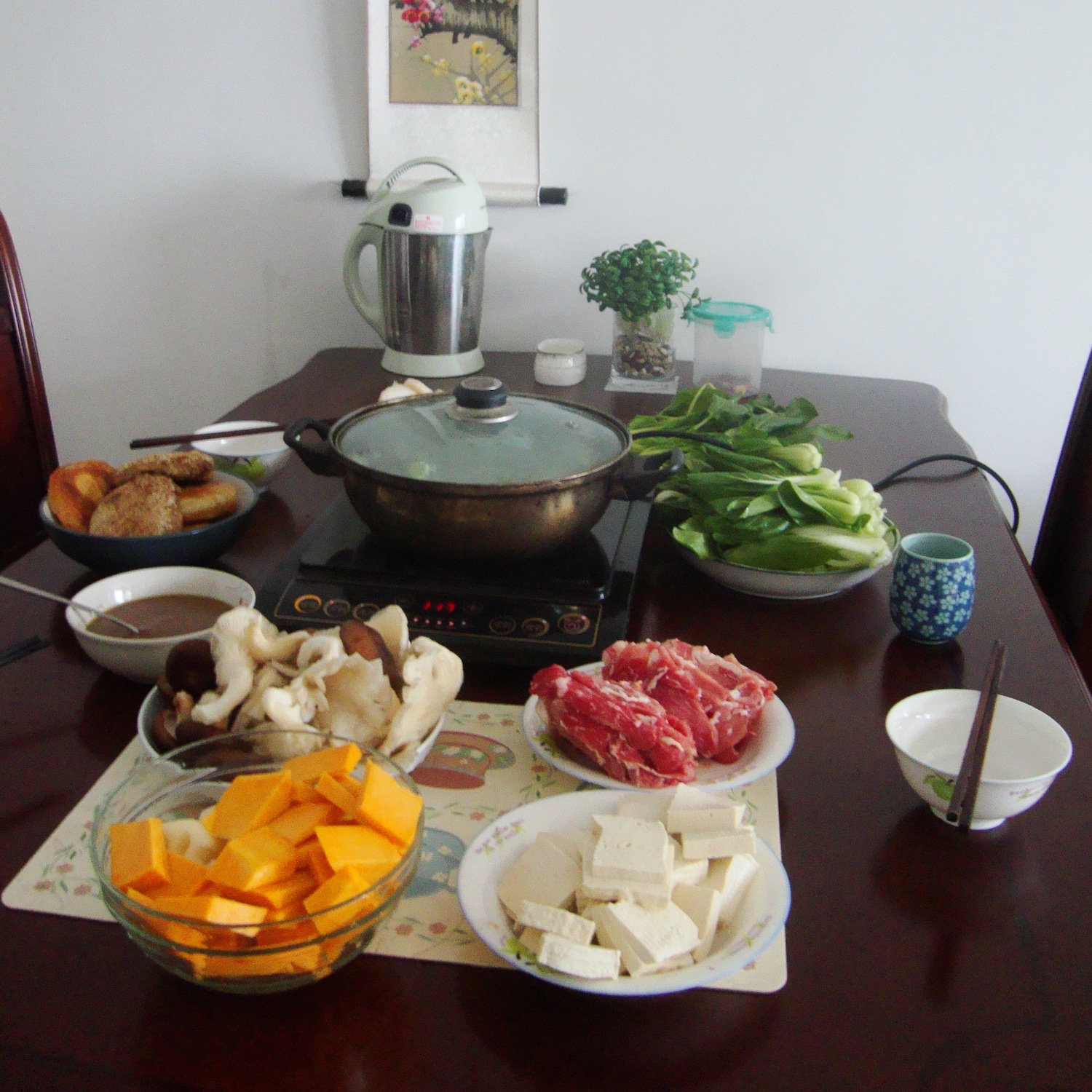
This past weekend, I made the trek all the way to Tongzhou, an eastern Beijing suburb about an hour outside the city center. A few friends and I were getting together at one of their apartments. The weather was pretty dreary all day, with overcast skies, and everything was all damp. But it was good for hanging out inside, watching movies, playing video games, and of course, making hot pot. We stopped by the market to pick up the ingredients — lamb and beef slices for our meat, as well as lotus root (藕, ou), pumpkin, tofu, spinach, you cai (油菜, or what is sometimes called baby bok choy or Chinese cabbage), and mushrooms mushrooms mushrooms! Thankfully, my friends also share my love for mushrooms, and knowing that I can’t eat them when my boyfriend’s around, we bought four different kinds: shiitake, wild enoki, oyster and king oyster. We prepared a clear broth and sesame dipping sauce, cut up all the vegetables, et voila:

Homestyle hot pot
Homestyle hot pot

Hot pot (火锅, huo guo, which literally means “fire pot” in Chinese) is a Chinese favorite. Hot pot restaurants can be found everywhere in China, as ubiquitous as homestyle restaurants and roadside barbecue stands. They are usually packed, and if you’re not eating it in a restaurant, you’re probably eating it at home. It’s convenient, it’s delicious, it’s healthy, it’s fresh, and there’s all sorts of room for creativity. Different regions have their own version of it: uber-spicy mala (麻辣) hot pot from Chongqing/Sichuan; Yunnan mushroom hot pot; traditional Beijing-style hot pot with a coal stack and clear broth; some kind of nasty fish hot pot, where you eat all the fish before cooking anything in it; Guangdong-style seafood hot pot; mutton hot pot. Haidilao* (海底捞火锅), perhaps the most popular hot pot restaurant at the moment among both Chinese and foreigners, is designed to impress, with a variety of broths and dipping sauces to choose from, as well as chefs that prepare noodles fresh in front of you. Fast food-style hot pot restaurant chains, such as Xiabu Xiabu and Little Sheep, have also cropped up, where patrons order their own small pot of broth and a few meat and vegetables. In Beijing, one of our friends, who is from Chongqing, swears by Yang Jia Hot Pot (杨家火锅), an independent and wildly popular shop run by another Chongqing native. When I was younger, we would often eat hot pot in the winter — a pot of stew cooking at the dinner table really is good at warming you up. For some reason, I never really appreciated it until I came to China. But even though foreigners love to eat it here, hot pot still hasn’t seemed to catch on in the West. Hopefully, as Chinese hot pot restaurants expand overseas, the rest of the world will learn to love it too.

On another note, my right eye had been acting strange all day. It was producing eye gunk like crazy and my vision kept going blurry, and by evening, it had started to turn noticeably red. I thought I was getting another eye infection, of the variety that caused me to go to the hospital a few years ago. Luckily I still had some of the medicine I had used. But on my way home from Tongzhou, another friend called and asked if I wanted to check out this new bar/barbecue joint that was offering free beer. Perhaps foolishly, I went along for a quick two pints, then headed home to take care of my eye. But on the way, I noticed it was no longer feeling so weird, and when I got home, whatever was going on seemed to have cleared up. Now, I’m not a doctor of medicine, or of anything else for that matter, but I’m attributing the healing to the alcohol**.

* Haidilao is coming to America.

** Disclaimer: I do not recommend this “remedy” to anyone else, for eye infections or any other medical issue.

A new front in China’s war on pollution: Industrial emissions

After announcing last month a plan to curb air pollution by banning outdoor barbecues, which was appropriately met with much derision, Chinese officials seem to have stumbled onto something that might actually go toward fixing the air problem: Ordering companies in heavily-polluting industries to cut emissions by 30 percent by 2017. The new rules appear to be made in somewhat earnestness, even though (as usual) it’s not completely clear what exactly is going to happen yet. According to the BBC:

Under the new rules companies will be legally obliged to improve their pollution control equipment and will be penalised for excess emissions.

The State Council announced the emissions targets as part of a document that approved 10 measures for tackling environmental problems, including:

  • Curbing the growth of energy-consuming industries like steel, cement, aluminium, and glass
  • Refusing permission for new industrial projects if they failed to meet required standards
  • Strengthening enforcement of the current penalties regime

Will they work? Considering the slowdown in China’s economy and tightened credit, they just might!

Behind the Agricultural Exhibition Center

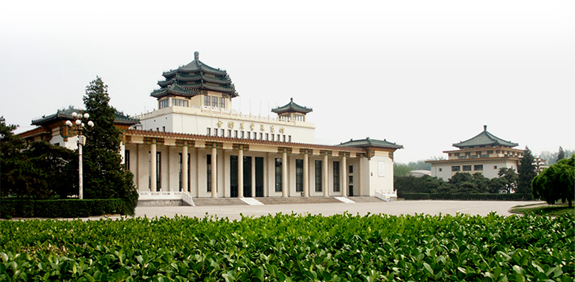
On one of my first weekends in Beijing, I was invited to go out to Sanlitun by someone else who was also new to the city. It was the first time I had heard about it, and needless to say, he gave me shitty directions: “It’s near the [subway] stop either before or either the Agricultural Exhibition Center.” He couldn’t remember what the name of the actual subway stop was (it’s Tuanjiehu). However, the Agricultural Exhibition Center (全国农业展览馆) is one of the few stops that’s not in Chinese*, though ironically, despite its English name, it’s not really a place that many foreigners would go**. Situated at the end of Dongzhimen Outer Street on the East Third Ring Road, it is first buffered by a 10-lane wide entrance and a sprawling expanse of pavement. Finally, at the end of this plaza, the main building rises imposingly, flanked by a few other smaller-but-still-large side buildings. Unlike other government buildings, such as the Great Hall and National Museum around Tiananmen Square, which are textbook Soviet-style monoliths of functionalism, the Agricultural Exhibition Center actually has hints of traditional Chinese architectural flourishes. Unfortunately, its very name acts as a deterrent for would-be visitors. What goes on at an exhibition center for agriculture — grain displays? Not a very exciting prospect. On top of that, any chance it could have had is completely wiped out by the fact that there is nothing else around it. Its dedicated subway stop only has two exits, one at each end of its entrance (yes, the entrance spans the length of a whole subway train). Across the street are heavily gated embassies, and for anything down the street, you’d be better off getting off at the next subway stop. Still, it’s probably one of the first landmarks that foreigners can locate, simply because it has a convenient English name.

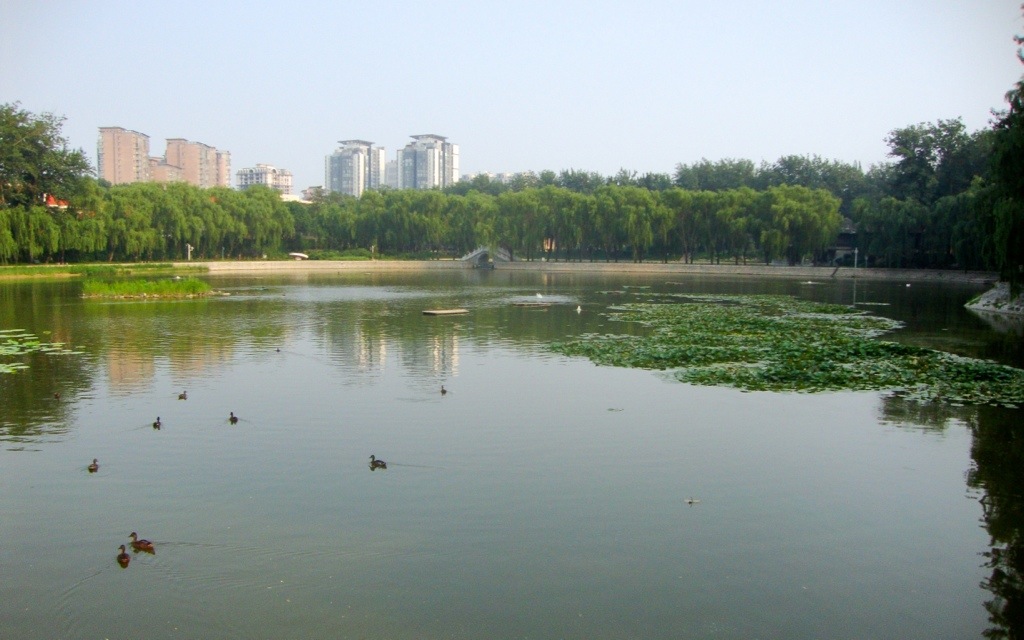
Anyway, a friend and I decided to check it out yesterday. Currently, there is a 外贸 (waimao) market going on in one of the side halls. Dozens of manufacturers from around the country that produce goods destined for foreign trade have set up stalls inside to sell off some heavily discounted wares that perhaps did not meet quality standards, but were nonetheless still suitable for sale, at least in China. I snagged a silk scarf for 50 yuan ($8.15), a bargain considering that name-brand scarf shops can sell them for more than 10 times as much. But the nicest surprise about the Agricultural Exhibition Center, and the reason we went to check it out, was the landscaping behind the buildings. A small pond, dug during the Qing Dynasty, surrounded by drooping willows, offered a tranquil spot for a stroll, a jog, or an afternoon of reading. The pond right now is half overtaken by giant lotus pads, ready for the blooms next month, but there were also a few ducks and ducklings swimming about. Even in a sprawling city like Beijing, it’s extremely difficult to find such a nice, quiet spot to relax in the shade. Parks are nice, but usually spoiled by the crowds. This spot behind the Agricultural Exhibition Center was not. My friend and I agreed to keep it that way and not tell anyone, so I guess I shouldn’t be writing about it, but I’m just too excited to have found something close by and different.

Away from the maddening crowd.

* The others are Yonghegong Lama Temple, the National Library, various railway stations, a far-out amusement park, and the even farther-out Garden Expo Center, which just opened last month.

** Once, there was a fashion show of a big designer that a bunch of celebrities attended. I thought it was Diane von Furstenberg, but Google is saying it was Hugo Boss last year. And that’s about as much publicity that I know the Agricultural Exhibition Center has gotten in the few years I’ve lived in Beijing.

Photo from China Agricultural Museum’s website.